
I still remember sliding into a cracked red vinyl booth at a railside diner in Pennsylvania, staring at a weathered chalkboard that read: Today’s Blue Plate: Salisbury Steak, Mashed Russets, Green Beans, Roll — $7.50. When the meal arrived, it sat on an ordinary white stoneware plate, without a trace of blue in sight. That contrast gnawed at my curiosity: how the blue plate special got its name has turned into one of the most persistent culinary detective stories in American roadside dining.
The phrase evokes images of counter stools, whistling steam tables, and no-nonsense waitresses refilling bottomless porcelain mugs. But behind that nostalgic mental picture sits a calculated piece of restaurant operational engineering, a ceramic design choice, and an etymological myth that almost everyone gets wrong.
The True Origin: Separating Railway Myth from Diner Reality
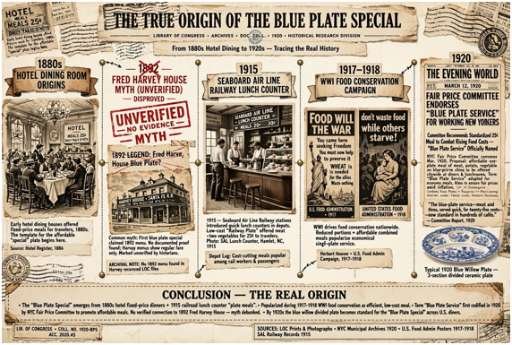
If you ask casual food historians about the phrase, they will point you to the legendary restaurateur Fred Harvey. Harvey operated the depot restaurants and luxury hotels along the Atchison, Topeka and Santa Fe Railway. For decades, popular lore claimed that the term first appeared in print on an October 22, 1892 Harvey House menu.
Working through depot preservation archives, a different historical timeline emerges.
1880s–1890s: Multi-dish hotel dining dominates
│
▼
1915: Seaboard Air Line Railway introduces unified one-plate specials
│
▼
1917–1918: WWI food conservation boards demand dishware and waste cuts
│
▼
1920: NYC Fair Price Committee standardizes “Blue Plate Service” in restaurants
│
▼
1929–1939: Great Depression cements the low-cost compartmentalized plate nationwide
The 1892 Fred Harvey Legend vs. Verified Print Records
The 1892 Harvey House citation traces back to an assertion made by the late food writer Daniel Rogov. Despite extensive preservation of Santa Fe line memorabilia by institutions like the Smithsonian National Museum of American History, no physical specimen of that October 1892 menu has ever surfaced in public collections.
Curators of Harvey House collections note that while Harvey popularized lightning-fast meal turnovers, telegraph ordering, and strict service standards, his trackside dining rooms favored fine European silverware and Syracuse China over everyday blue ceramic crockery.
Verified print records paint a clearer timeline. Searches in the Library of Congress Historic Newspaper Archives reveal that the term began appearing in print during the 1910s.
The earliest documented industrial use surfaced in 1915 on the Seaboard Air Line Railway. The rail line advertised a daily lunch of meat and two vegetables delivered on a single dish to streamline depot stops.
By 1917 and 1918, World War I federal conservation boards urged public dining establishments to minimize dish inventory, reduce food waste, and eliminate fussy table settings. The one-dish meal fulfilled both wartime thrift and logistical speed.
From Pullman Cars to Post-War Urban Lunchrooms
When soldiers returned from Europe, cities swelled with office staff and factory workers who had brief lunch breaks.
By late 1920, the New York City “flying squadron” of the federal Fair Price Committee pushed Manhattan hotels and lunchrooms to offer fixed-price meals to combat post-war inflation.
Establishments such as the Hotel Commodore and local lunchrooms introduced designated “blue plate luncheons” for around 50 cents to one dollar.
The phrase was no longer depot jargon. It was official retail vocabulary for a single-plate meal served in under ten minutes.
The Anatomy of the Divided Ceramic Plate
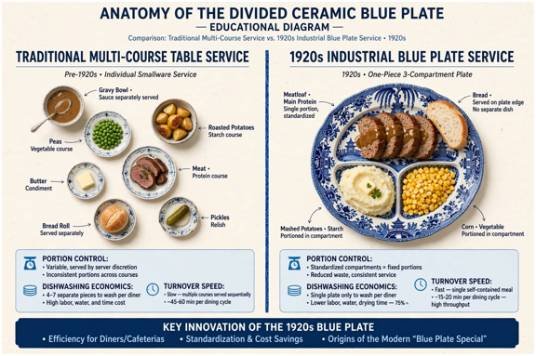
The name did not simply describe a menu pricing strategy. It described physical dishware.
Before the single-plate concept took hold, formal restaurants operated under the table d’hôte or French service model. A patron ordering a roast beef meal received their sliced meat on a main dish, while gravy, buttered peas, boiled potatoes, and dinner rolls arrived in a cluster of individual ramekins, bowls, and saucers.
Compartmentalized plates replaced that entire table setting.
| Dining Feature | Traditional Multi-Course Table Service | 1920s Industrial Blue Plate Service |
| Dishware Count | 4 to 7 individual plates, bowls, and saucers | 1 heavy divided stoneware plate |
| Kitchen Plating | Staggered across multiple prep stations | Single-line assembly from hot steam tables |
| Dishwasher Labor | Labor-intensive; requires extensive hand-drying | Mechanized high-heat washing in bulk wire racks |
| Portion Control | Variable by server and kitchen assistant | Hard boundaries set by ceramic compartment wells |
| Turnover Speed | 45 to 75 minutes | 15 to 20 minutes |
Why Blue? The Role of Willow Ware and Ceramic Glazes
Why did diners settle on blue instead of green, red, or white? Two factors drove that palette:
- The Popularity of “Blue Willow” China: In the late 19th and early 20th centuries, inexpensive transferware imported from England and manufactured domestically by pottery companies like Shenango, Buffalo, and Syracuse featured the intricate “Blue Willow” pattern. It became the most recognizable dinnerware in American dining. Serving home-style food on blue ceramic provided customers with an immediate impression of rustic comfort.
- Cobalt Pigment Stability: Cobalt oxide was the most dependable, heat-resilient color agent for industrial commercial kilns. Cheap restaurant vitrified china was fired at intense temperatures so it could withstand commercial kitchens without chipping. Cobalt blue held its rich color beneath thick protective glazes without discoloring or reacting to acidic foods like tomatoes, vinegar, or gravies.
Dishwashing Economics and Labor Efficiency
For independent lunchroom operators, switching to a heavy three-compartment plate cut operational overhead. Washing one thick ceramic plate instead of four delicate china dishes reduced dish breakage, lowered hot water consumption, and reduced the kitchen workforce. In an era before advanced automated dishwashers, turning tables quickly depended on how fast the kitchen cleaned plates.
The food itself was assembled directly off steam tables. The server placed meatloaf into the main compartment, scooped mashed potatoes into the left depression, ladled canned corn into the right, and placed a slice of white bread across the edge. The plate acted as portion control, menu design, and timing mechanism all at once.
How the Great Depression Cemented the Blue Plate Identity
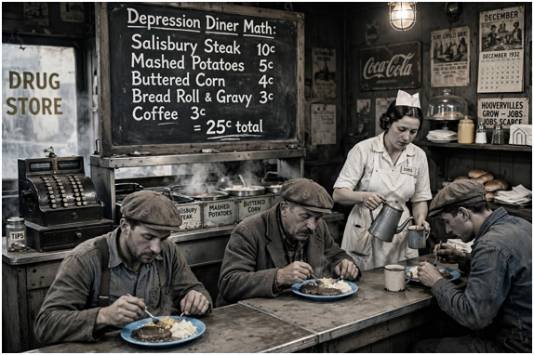
When the stock market collapsed in 1929, the blue plate special shifted from a convenience item to an economic lifeline.
Working Americans needed filling, hot food for pocket change. Diners, drug store lunch counters, and greasy spoons designed their menus around fixed 25-cent or 35-cent combinations.
The format shielded consumers from unexpected charges: bread, a starch, a vegetable, gravy, and a cup of black drip coffee came standard under one price.
The blue plate also gave diner cooks a reliable way to manage daily food waste. If a cook had excess braised brisket or turkey from Sunday dinner, those ingredients re-emerged on Monday afternoon mixed into hash or capped with thickened brown gravy.
Because diners did not allow substitutions on specials, kitchens accurately forecasted inventory, kept ingredient costs predictable, and ensured that no perishable stock went unused.
Depression Diner Math (1932 Average: 25¢ Total Ticket):
┌────────────────────────┬────────────────────────┐
│ Salisbury Steak (Main) │ Mashed Potatoes (Starch│
│ 10¢ value │ 5¢ value │
├────────────────────────┼────────────────────────┤
│ Buttered Corn (Side) │ Bread Roll & Pan Gravy │
│ 4¢ value │ 3¢ value │
├────────────────────────┴────────────────────────┤
│ Bottomless Filtered Coffee: 3¢ value │
└─────────────────────────────────────────────────┘
The blue plate represented a fair culinary contract during lean times: you received hot, respectable portions, and the owner kept their restaurant solvent.
Over the decades, changes in tipping etiquette and automated restaurant checkouts reflected shifting customer expectations, yet the basic premise of the fixed-price diner special remained unchanged.
Nostalgia, Modern Menus, and the Heritage Revival
By the late 1960s, segmented ceramic dinnerware began fading from commercial kitchens. Fast-food drive-thrus with paper wrappers captured the quick-lunch market, while full-service family restaurants adopted plain white china to emulate upscale dining rooms. The phrase itself drifted into television punchlines, often deployed as shorthand for early-bird discounts at Florida retirement spots.
Over the past decade, however, the revival of retro diners has reversed that decline.
Chefs across the country have embraced blue plate programs as an intentional rejection of high-end tasting menus. They are reviving the format with heritage-breed braised pork, locally sourced vegetable medleys, and buttermilk biscuits, frequently sourced on authentic vintage compartmentalized restaurant ware. The name remains compelling because it promises honest, hearty food served without pretension.
Frequently Asked Questions About the Blue Plate Special
1. What came on an original blue plate special?
A classic 1920s blue plate featured a central portion of meat (meatloaf, roast pork, or country steak) alongside two hot vegetable sides, gravy, bread, and a cup of coffee.
2. Did the Fred Harvey Company invent the blue plate special?
Historical records show no verified proof of the phrase on 1892 Fred Harvey menus; the terminology arose in rail and urban dining print records between 1915 and 1920.
3. Why were the original diner plates colored blue?
Commercial potteries frequently used cobalt blue glazes because they were durable, heat-stable, and evoked the nostalgic, wildly popular “Blue Willow” transferware pattern.
4. Is a blue plate special the same thing as a meat-and-three?
They share the same philosophy, though the Southern “meat-and-three” traditionally gives diners their choice of three custom sides, whereas a blue plate special featured fixed items chosen by the cook.
Order Like a Pro: Clean Your Plate
Next time you step into an authentic American lunch counter, bypass the laminated multi-page specialty menu. Look up at the wall or scan the paper table insert for whatever dish sits beneath the daily handwritten header.
When you order the daily fixed special, you participate in a century-old dining system built for working people. You receive the freshest prep in the building, help the kitchen maintain zero waste, and save money in the process. Treat your server with care, enjoy the meal, and appreciate the century of dining ingenuity packed into that humble, divided plate.