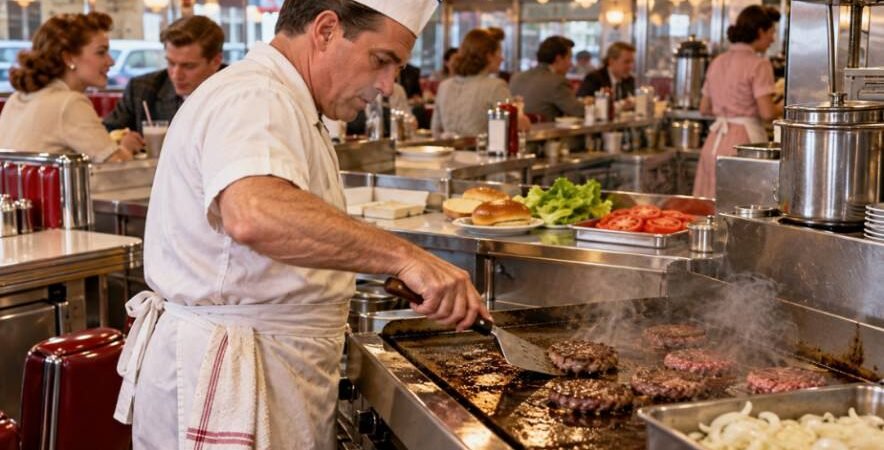
The first time I stood behind a short-order line during a Sunday morning rush, a ticket came flying through the pass with a shout: “Adam and Eve on a raft, wreck ’em, burn the British, draw one in the dark!” The line cook never blinked. Within four minutes, two scrambled eggs rested on thick toast alongside a charred English muffin and black coffee.
Having common diner lingo and waitress slang explained reveals that this rapid-fire dialect was never just nostalgic novelty; it was an ingenious auditory operating system built to survive grease smoke, sizzling flat-tops, and clattering porcelain.
Before digital ticket printers or touchscreen kitchen display systems existed, auditory memory governed hospitality. When diners boomed across America, waitstaff relied on rhythm, rhyme, and visual comedy to communicate complex orders without scribbling endless paragraphs on paper pads.
The Short-Order Shorthand: How Diner Talk Actually Worked
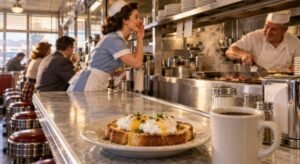
Working along a classic american diner counter teaches you that counter lingo served a functional mnemonic purpose.
This informal, fast-paced style of service is closely associated with the greasy spoon restaurant, where affordable comfort food, counter seating, and straightforward hospitality have long defined the dining experience.
If a server simply yelled “two fried eggs and a hamburger with onions,” the sound blended into ambient dining room chatter. Shouting sharp, punchy phrases cut through steam vents and jukebox bass.
Historic lunch counters documented by the Smithsonian Institution developed these spoken codes during the 1920s to optimize order turnover. Cooks memorized the cadence of the calls to orchestrate grill space without cross-contaminating flavors or miscalculating cooking times.
Classic Counter Call -> Flat-Top Action
“Burn one, drag it” -> Slap raw patty on high-heat center plate
“Whiskey down” -> Drop two slices of rye bread into toaster slots
“Adam & Eve, wreck” -> Crack two eggs directly into hot butter; scramble immediately
Breakfast on the Line: Rafts, Cackleberries, and Axle Grease
Eggs formed the backbone of the diner business model, requiring specific, fast nomenclature. A standard order of two poached eggs arrived as “Adam and Eve on a raft,” referencing the biblical pair perched safely upon a slice of toast. If the guest preferred them scrambled, the counter call turned destructive: “Adam and Eve on a raft, wreck ’em.”
Standard fried eggs went by “cackleberries” or “hen fruit.” When a regular requested buttered white toast with strawberry jam, the server bellowed for a “shingle with a shimmy and a shake.” The bread represented the roofing shingle, butter provided the shimmy, and fruit preserves delivered the shake. Meanwhile, butter itself was routinely called “axle grease” or “cow paste,” while pancakes ordered with extra butter were summoned as a “stack with skid chains.”
Griddles and Cuts: Burn One and Drag It Through the Garden
Proteins required distinct timing calls so cooks could prioritize sear orders. “Burn one” instructed the cook to press a fresh hamburger patty onto the steel flat-top grill.
Executing calls like these was central to the role of the short order cook in diner culture, requiring cooks to translate colorful shorthand into precise movements while maintaining speed and consistency on the griddle.
If the patron wanted full produce garnishes—lettuce, sliced tomatoes, and raw white onions—the server added “take it through the garden.”
Whenever a customer demanded raw onions on their sandwich, waitstaff shouted “pin a rose on it” or “make it cry,” nodding to the pungent tears shed while prepping alliums. Steaks followed comparable visual shorthand: an order cooked rare arrived “still mooing” or “on the hoof,” whereas a dried-out, well-done burger was announced plainly as a “hockey puck.”
The Secret Numeric Dialect Behind the Fountain Counter
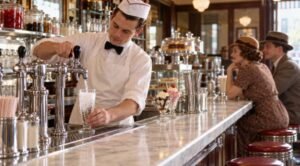
While food calls were deliberately loud and theatrical to entertain sitting guests, soda jerks and counter clerks operated a secondary, covert communication network. These numeric codes allowed staff to pass critical security and inventory updates across a packed room without causing panic or offending customers.
Deconstructing 86: Rhymes, Fountains, and Walter Winchell
No phrase in American restaurant history carries more myth than 86. Internet forums often credit the term to Chumley’s speakeasy at 86 Bedford Street in Manhattan, claiming police warned bartenders to hustle guests out the rear door before raids. Others point toward 86-proof whiskey or eight-foot burial plots.
Linguistic documentation disproves these colorful legends. In a seminal 1936 research paper published in the linguistic journal American Speech, Columbia University scholar Harold W. Bentley recorded real soda fountain operations. Bentley confirmed that lunch counter staff used numbers as internal shorthand, with 86 serving as rhyming slang for the 1930s term “nix”—meaning to cancel, discard, or refuse.
Columnist Walter Winchell documented the identical code in print as early as 1933, noting that 86 meant the kitchen had completely run out of an ingredient. Over decades, the phrase evolved from an out-of-stock notification to the universal hospitality verb for cutting off an intoxicated patron or firing a dish from the line.
[ 1930s Soda Counter Code ]
│
Rhymes with “NIX”
│
▼
┌─────────────────────────────────┐
│ “86” = We are out of that item │
└─────────────────────────────────┘
│
Expanded by mid-century to:
▼
┌─────────────────────────────────┐
│ 1. Cut off a disorderly patron │
│ 2. Remove an entree from menu │
│ 3. Eject/fire someone on staff │
└─────────────────────────────────┘
The Warning System: Decoding 13, 95, and 99
Beyond 86, lunch counters relied on numbered codes to monitor their dining rooms discreetly:
- Code 13: Signaled that the owner, big boss, or chain inspector had just walked through the front doors.
- Code 81: Demanded a simple glass of tap water, often poured for loiterers occupying high-turnover stools.
- Code 95: Alerted line workers that a customer was attempting a walkout without paying their ticket tab.
- Code 98: Identified the assistant shift manager approaching the floor.
- Code 99: Acknowledged the head manager or chief soda jerk on duty.
By speaking numbers rather than names, counter personnel preserved professional composure while maintaining strict surveillance over their stations.
Modern Pass-Through Jargon: From Ticket Slips to POS Terminals
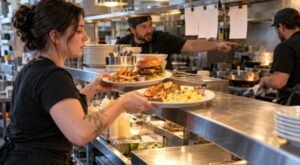
As corporate hospitality replaced independent lunch wagons, computerized point-of-sale systems eliminated the practical need to scream “Noah’s boy on bread” to receive a ham sandwich. Yet the restaurant industry never abandoned verbal shorthand; instead, language migrated toward front-of-house logistics, physical safety, and ticket pacing.
| Modern Restaurant Term | Operational Setting | Practical Floor Meaning |
| In the Weeds | Kitchen line or floor service | Drowning in pending orders and critically falling behind on service pacing. |
| All Day | Expeditor station | The total cumulative count of a specific dish needed immediately across all active tables. |
| On the Fly | The pass-through window | A missing or remade dish required instantly, bypassing typical ticket queues. |
| Campers | Dining room booths | Guests who linger at their table long after paying, halting server turnover. |
| Behind / Corner | High-traffic blind spots | Mandatory verbal safety calls shouted while navigating heavy trays or hot pans. |
| Deuce / Four-Top | Host stand | Precise table capacity designations for parties of two or four guests. |
Frequently Asked Questions
1. What does “Adam and Eve on a raft” mean in diner lingo?
It refers to two poached eggs served on top of a slice of toast.
2. What is the true linguistic origin of the restaurant term 86?
It originated in 1930s soda fountains as rhyming slang for “nix,” signaling that an item was out of stock.
3. What does the phrase “all day” mean to a line cook?
It represents the total number of a specific menu item required across all open kitchen tickets combined.
4. Why did classic diners create such elaborate code words?
Counter staff used colorful slang as an auditory mnemonic tool to communicate clear, prioritized orders over loud kitchen noise.
Order Up: Dropping the Check and Calling It Down
Diner lingo remains one of America’s most expressive contributions to working-class linguistics.
This language developed alongside the distinctive dining spaces that housed it, particularly the history of silver dining car restaurants, whose compact layouts and counter-service designs helped shape the classic American diner experience.
It turned a high-stress, hot-grease environment into a synchronized stage performance where speed, memory, and humor kept plates moving.
The next time you grab a stool at an authentic stainless-steel counter, skip the standard polite script. Order your eggs wrecked, ask them to burn the British, and tell the server to draw one in the dark—you will be keeping an indispensable piece of culinary folklore alive.