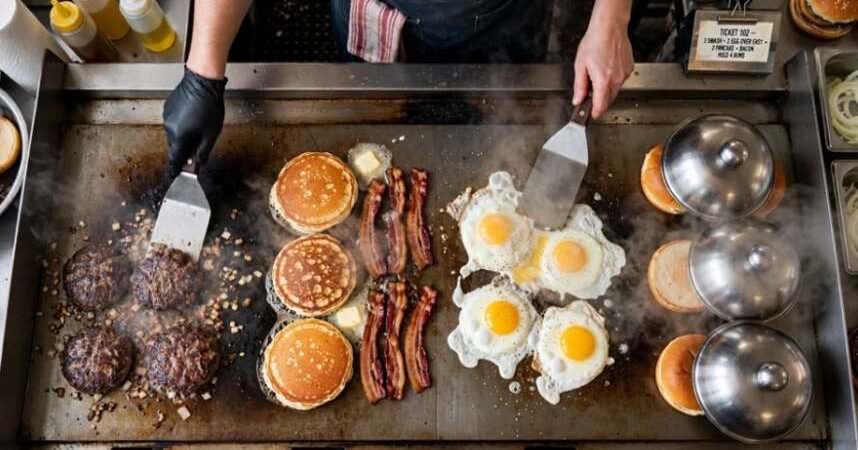
Pull up a swivel stool early on a Sunday morning, and you immediately sense the rhythm. The line sizzles, grease spatters rhythmically against stainless steel, and plates hit the counter without pause. The role of the short order cook in diner culture is that of an operational anchor, public performer, and neighborhood steward rolled into one.
While high-end culinary kitchens rely on sprawling teams, the diner line runs on the instincts of a solo operator who translates chaotic morning rushes into perfectly synchronized comfort food.
I spent years observing this dynamic from chrome-rimmed counter seats across the Northeast. A true short-order cook does not merely fry food; they direct an intricate, fast-moving ballet where seconds determine whether breakfast succeeds or fails.
The Cockpit Economy: Mastering the 30-Second Offset Rule
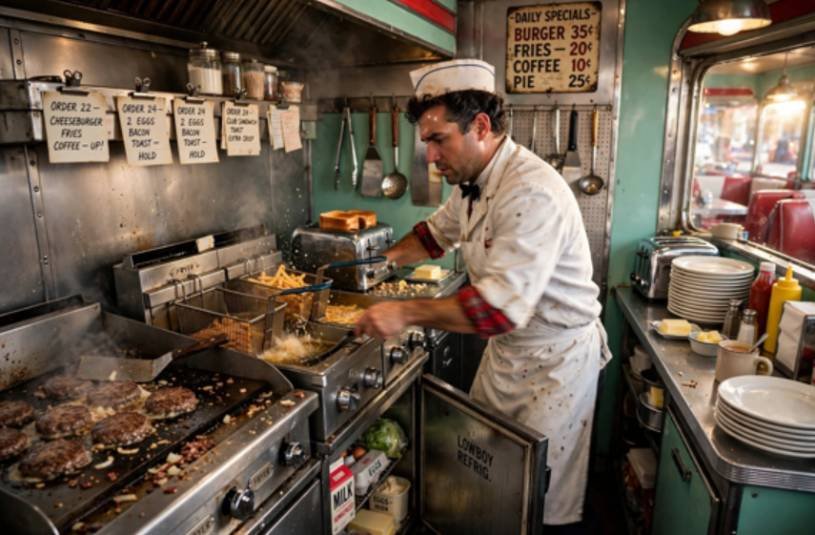
Unlike standard restaurant kitchens split into multiple remote stations, a diner line is an ergonomic cockpit. The cook commands a compact footprint, pivoting between the flat-top plancha, deep fryers, bread toasters, and lowboy refrigeration drawers without taking more than two steps in any direction.
According to technical culinary standards analyzed by The Culinary Institute of America, kitchen efficiency relies directly on minimizing wasted kinetic movement. In a classic diner, that theory becomes extreme practice.
Anatomy of the Flat-Top Heat Gradient
The flat-top grill is the engine of the entire house. A master cook never treats the griddle as a uniform hot plate. Instead, they calibrate it into four distinct thermal zones:
- Zone 1 (400°F–425°F): The hard sear zone, reserved for smash burger patties, crisping corned beef hash, and searing country ham.
- Zone 2 (350°F–375°F): The foundational cooking surface for golden pancake rings, French toast, and bacon strips.
- Zone 3 (300°F–325°F): The egg deck, calibrated so whites set firmly in clarified butter without blistering the delicate yolk edges.
- Zone 4 (200°F–250°F): The holding shelf, used to warm split potato buns, melt cheese under metal basting domes, and rest proteins.
Managing these zones requires constant spatial awareness. Shift an egg four inches too far left, and the yolk hardens before the toast pops; push it too far right, and the whites run clear.
+—————————————————————+
| THE FLAT-TOP TOPOLOGY |
| |
| Zone 1: Hard Sear | Zone 2: Griddle Deck | Zone 3: Eggs |
| (400°-425°F) | (350°-375°F) | (300°-325°F) |
| – Smash burgers | – Pancakes | – Over-easy |
| – Corned beef hash | – Bacon strips | – Omelets |
| – Sausage links | – French toast | – Scrambles |
+———————+———————–+—————–+
| Zone 4: Holding Deck (200°-250°F) |
| – Toasted buns – Melting domes – Resting meats |
+—————————————————————+
Ticket Management Without an Expediter
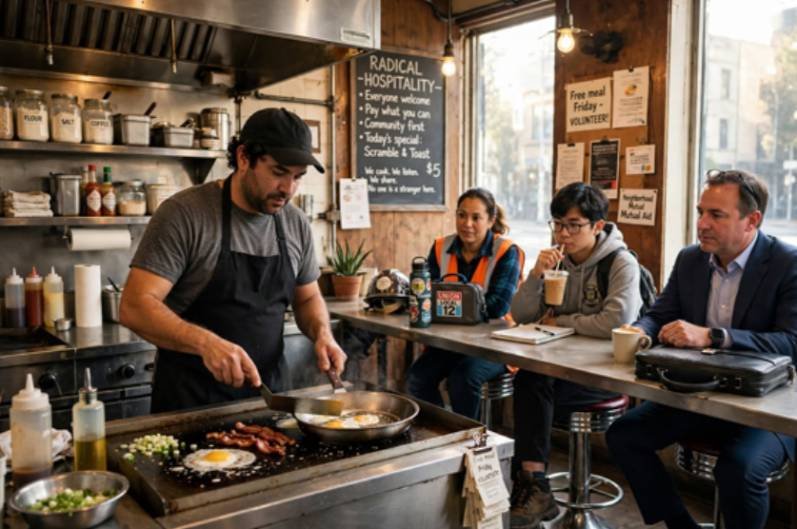
In classical dining, a dedicated expediter calls tickets and inspects plates at the pass. In a diner, the cook absorbs that mental load solo.
Consider a standard four-top order: a well-done strip steak, an over-medium egg platter with crispy hash browns, a stack of buttermilk pancakes, and a patty melt on rye. These items possess radically different cooking windows:
- Well-done strip steak: 10 minutes
- Crispy hash browns: 8 minutes
- Patty melt: 5 minutes
- Pancakes: 3 minutes
- Over-medium eggs: 90 seconds
- Rye toast: 60 seconds
The cook applies what I call the 30-Second Offset Rule. They calculate the longest cook time, drop the steak first, set the hash browns to crust, drop the burger patty five minutes later, pour the batter when the steak rests, drop the eggs ninety seconds before completion, and push down the toaster lever last. Everything lands on heated ceramic within a thirty-second window. Nothing wilts under a heat lamp because heat lamps rarely exist here.
Data on table turns from the National Restaurant Association shows that customer satisfaction in fast-casual formats drops sharply when ticket times exceed ten minutes. The short-order cook maintains sub-eight-minute ticket times during morning volume peaks purely through internal clock coordination.
Deciphering the Counter Dialect: Beyond Novelty Slang
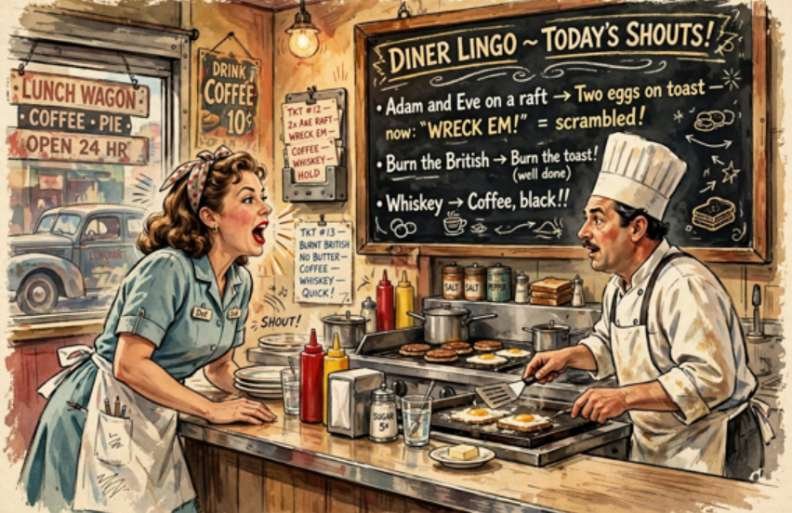
Diner slang often gets dismissed as mid-century nostalgia. In reality, it was developed as an essential oral compression protocol designed to survive chaotic line conditions.
Historical records from the Smithsonian Magazine trace these codes back to late 19th-century night lunch wagons. In cramped spaces, shouting long culinary descriptions wasted breath and invited transcription errors.
Acoustic Engineering on the Line
A bustling breakfast shift generates significant decibel levels: spatulas scrape steel, oil crackles, dishes clatter, and patrons converse. Standard syllables dissolve in that acoustic wash.
Diner lingo bypasses the noise by utilizing high-frequency, plosive consonants that pierce through the clatter:
- “Adam and Eve on a raft, wreck ’em!” replaced “Two scrambled eggs on toast.”
- “Burn the British!” commanded an English muffin on the grill.
- “Whiskey!” quickly signaled rye toast, using the sharp ‘k’ sound to avoid confusion with white bread.
- “Draw one in the dark!” demanded black coffee straight from the urn spigot.
These shorthand phrases functioned like modern internet packet data: compressed, error-resistant, and instantly decodable.
Preserving Diner Counter Culture
Beyond speed, this linguistic dance preserved workplace morale. Waitstaff and cooks developed verbal choreography that transformed physical labor into daily performance art. Even as computerized ticket printers gradually replaced shouted calls in a greasy spoon restaurant, the vocabulary cemented an undeniable cultural bond between the front counter and the back line.
The Library of Congress maintains sound recordings of counter workers from the 1930s and 40s, highlighting how these cadence calls gave working-class food service a distinct professional identity.
The Counter Stage: Transparency, Community, and Radical Hospitality
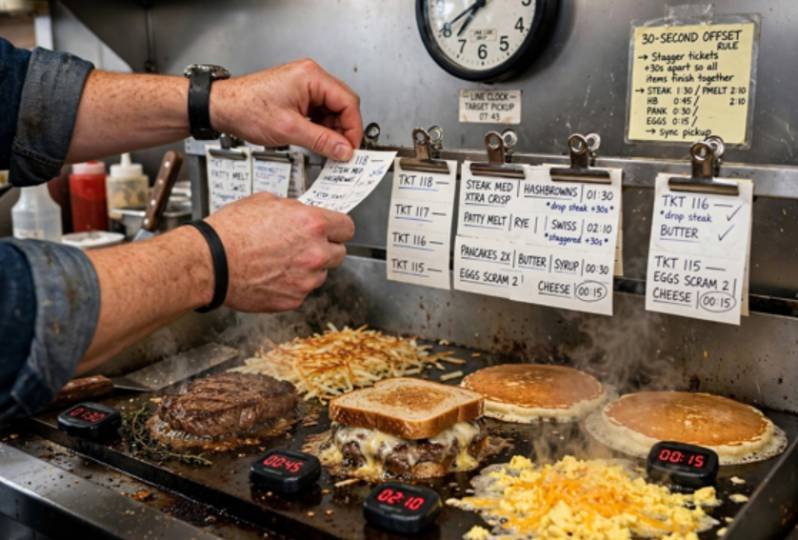
The defining architectural feature of traditional diners is the absence of a dividing wall. The cook operates entirely in public view, turning the prep line into an open proscenium theater.
Navigating the Line and Counter Etiquette
Counter dining has always maintained an unwritten social contract. Patrons perched on swivel stools watch raw ingredients transform into meals just three feet away. This transparency enforces accountability; you see the cleanliness of the butter well, the scrape of the grill brick, and the fresh crack of every shell.
Observing proper counter seating etiquette means recognizing when the cook is locked in the zone. During a 9:00 AM rush, regulars know not to interrupt a cook tracking twelve active orders.
Once the rush breaks, however, that same cook becomes the local sounding board, historian, and neighborhood confidant. They remember who takes their home fries extra dark and who needs their coffee refilled before the mug hits empty.
Democratizing Custom Orders
Fine-dining institutions historically guard their recipes against customer alterations. In stark contrast, the short-order cook practices radical accommodation.
Customization is the baseline expectation of diner food:
- Breakfast served at midnight.
- Burgers grilled at 7:00 AM.
- Egg whites flipped soft with sliced tomatoes instead of potatoes.
The cook fulfills these requests without judgment or pretension. This hospitality structure democratized dining out across twentieth-century America, creating spaces where factory workers, students, and executives sat side-by-side eating identical fare prepared by the same pair of hands.
That communal dining tradition also has parallels with the practical rules and shared customs found in lumber camp mess halls, where meals served an important social and functional role beyond simply providing food.
Frequently Asked Questions
1. What is the primary role of the short order cook in diner culture?
The short-order cook serves as the kitchen’s engine, executing rapid, synchronized custom comfort meals while anchoring customer community directly from an open counter.
2. How does a short-order cook differ from a line cook?
A short-order cook manages the entire meal line and ticket sequence solo, whereas a traditional line cook works a single specialized station within a larger brigade.
3. Why did diners develop their own unique lingo?
Diners created verbal shorthand to communicate orders clearly over loud kitchen noise, minimize order errors, and speed up ticket turnaround times.
4. What is the most critical piece of equipment for a diner cook?
The multi-zone commercial flat-top grill is the essential centerpiece, allowing simultaneous searing, frying, grilling, and warming across distinct heat zones.
Don’t Forget to Tip the Line
Next time you slide onto an upholstered booth or chrome counter stool, pause before diving into your stack of pancakes. Watch the cook’s hands. Notice the rhythmic scrape of the spatula, the mental calculation behind three simultaneous tickets, and the steady calm anchoring the heat.
The diner endures because its line cooks treat quick-service hospitality as an art form rather than an assembly chore. Leave a generous tip on the laminate counter, say thank you on your way out the door, and appreciate the craftsmanship holding American diner culture together.