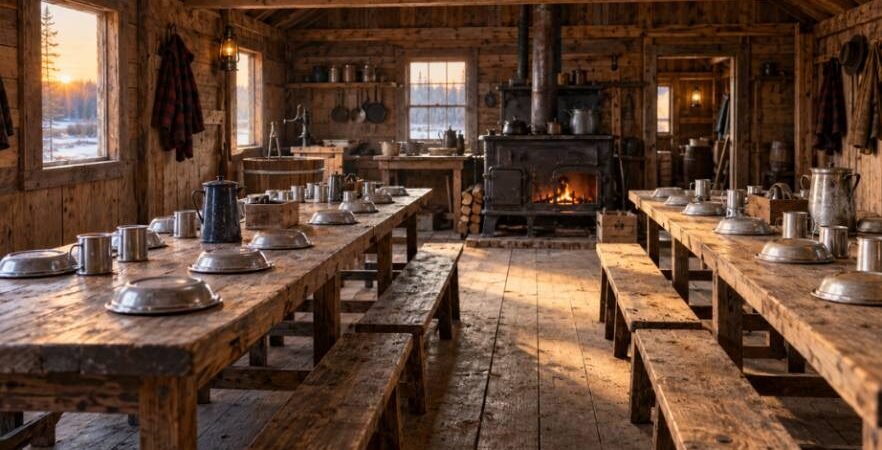
Standing inside the restored 1890s cook shanty at the Hartwick Pines lumber camp, the silence feels heavy. Long white-pine tables stretch from the cast-iron ranges toward the door, set with tin plates turned face-down. Historical lumber camp mess hall rules and dining traditions treated eating not as a social leisure, but as an aggressive industrial refueling operation.
Every logger burned between 6,000 and 8,000 calories a day felling virgin white pine in zero-degree timber stands. To keep eighty exhausted men from fighting or wasting working daylight, logging outfits ran their mess halls with naval discipline.
+————————————————————————–+
| HISTORICAL COOK SHANTY OPERATIONAL PROTOCOL (1880–1920) |
| – Meal Duration: 15–20 minutes maximum |
| – Vocal Noise: Zero decibels (speaking prohibited except for condiments)|
| – Table Setting: Plates/cups inverted until seated (sanitation shield) |
| – Caloric Target: ~8,000 kcal/day (45% carbs, 35% fats, 20% proteins) |
+————————————————————————–+
Stepping Across the Cookhouse Threshold: The 15-Minute Rule
The moment loggers crossed the threshold of the cook shanty, the clock began ticking. Men took their seats, shoveled steaming food into their mouths, and exited within fifteen to twenty minutes. Lingering was grounds for immediate removal.
Camp managers calculated that an idle crew at the dinner table cost real timber volume at the landing. Furthermore, the kitchen staff needed every available minute between shifts to scrape grease, wash tinware, and mix dough for the subsequent shift.
The Law of Absolute Table Silence
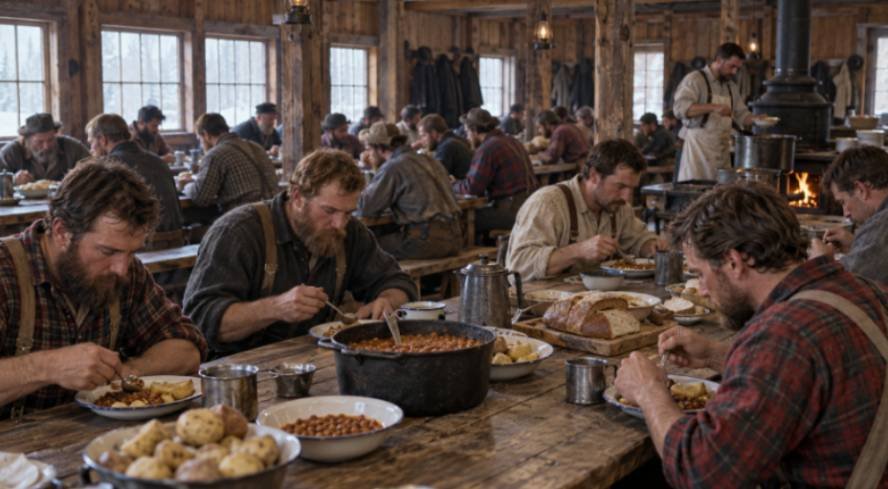
The most jarring tradition to modern visitors was the absolute ban on talking. A crew of sixty men ate together in near-total silence, broken only by the scrape of steel knives against tin plates. Camp directors enforced this rule through the kitchen staff for two distinct reasons:
- Digestive Velocity: Men who chat eat slowly. A quiet room emptied twice as fast as a conversational one.
- Conflict Prevention: Logging camps gathered men from rival immigrant groups—Finns, Swedes, Irish, French-Canadians, and native-born Yankees. Combined with grueling physical exhaustion and short tempers, political or religious arguments sparked sudden brawls. Prohibiting speech eliminated saloon-style clashes before they could ignite.
If a timber cruiser needed something down the table, he pointed or barked a single syllable. Asking for the salt was permissible; discussing the timber cut was not. Archival documentation at the Forest History Society demonstrates that camp operators fired workers on the spot for repeatedly violating mealtime silence.
Assigned Benches and Downward-Facing Tinware
Chaos had no place on the bench. Each man received a permanent seat on his first day in camp. Veteran teamsters sat together, fallers clustered along their own benches, and swampers took remaining slots. This eliminated the daily scramble for seats when seventy men entered the room at once.
Cookees arranged the tables symmetrically between meal services. Plates, tin cups, and bowls rested upside-down against the bare wood. In an era before sealed windows or mechanical air filters, soot from cast-iron stoves and dust from wool mackinaws drifted continuously through the air. Inverting the dishware kept the eating surface free from grime, soot, and flies until the logger flipped his plate over.
The Cook Shanty Hierarchy: Kings, Cookees, and the Gut Hammer
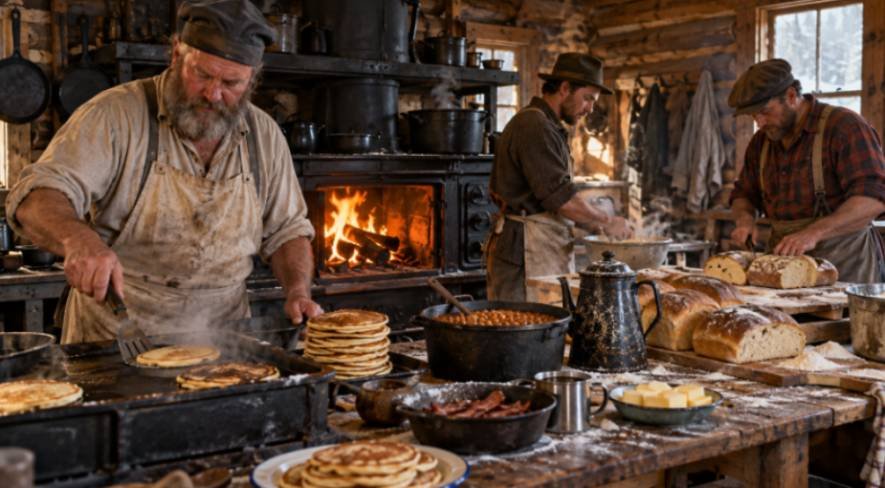
The camp superintendent controlled the woods, but the head cook ruled the camp compound. Known as the “cook boss” or the “bull cook” in early shanties, this individual wielded absolute authority over anyone entering the kitchen door.
+————————+
| HEAD COOK |
| (Absolute Authority) |
+———–+————+
|
+————+————+
| |
+——+——+ +——+——+
| COOKEE | | COOKEE |
| (Prep/Dish) | | (Prep/Wood) |
+————-+ +————-+
Why the Head Cook Outranked the Camp Boss
A skilled lumberjack followed the grub. Companies that hired cheap cooks—derisively branded “belly robbers”—watched their entire crews walk off the job to seek competing outfits along the river.
Historical payroll receipts conserved by the Library of Congress reveal that top-tier camp cooks earned higher base compensation than the logging foremen supervising the timber cuts. A head cook organized purchasing, managed tons of dry goods, prevented scurvy, and commanded his kitchen crew with strict precision.
Beneath the head cook worked the cookees (referred to as “flunkies” across Pacific Northwest camps). These young men split firewood, carried hundreds of gallons of water from frozen creeks, peeled fifty-pound sacks of potatoes, and ran heavy enameled platters down table centers during feeding rushes.
The Gabriel Horn and the Call to Scarf
Loggers did not wear wristwatches into the brush. Work stopped when sound traveled through the timber. The cook stepped outside the shanty door and sounded the “Gabriel Horn”—a flared tin trumpet measuring up to eight feet in length.
When wind conditions muffled the horn, cooks relied on the “gut hammer.” This implement consisted of an iron bar struck against a hanging iron triangle or a discarded section of steel railroad track. The penetrating, high-frequency ring carried two miles across frozen ridges. The moment the triangle rang, fallers dropped their crosscut saws and marched back to camp.
GABRIEL HORN (Long-Distance Audio) ──► Echoes 2+ Miles through Pine Stands
GUT HAMMER (Immediate Camp Rail) ──► Alerts Men to File In Immediately
Fueling 8,000 Calories a Day: The Daily Logging Menu
Felling trees by hand in waist-deep snow consumed massive energy reserves. Modern sports nutritionists estimate that a crosscut sawyer expended roughly 800 calories per hour of active labor. To prevent rapid muscle wasting, the cook shanty provided continuous fuel heavy in saturated fats and complex carbohydrates.
Morning Sweet Pads and Sourdough Stacks
Breakfast landed on the tables by 5:00 AM. Stacks of yeast-raised flapjacks, known in camp vernacular as “sweet pads,” stood alongside platters of salt pork, fried salt beef, boiled potatoes, and stewed prunes. The prunes appeared at almost every sitting to aid digestion on an otherwise fiber-poor diet.
Loggers washed breakfasts down with scalded black tea or bitter coffee served in heavy ceramic mugs. Men needed sturdy dishware that could withstand rough treatment on wooden benches, an engineering trait that explains why do diners always serve coffee in thick ceramic mugs throughout North America today.
Midday Cold Lunches on the Sled Trail
Crews working several miles from the home camp could not hike back to the mess hall for the noon meal. In early logging eras, men carried cold biscuits and fat salt pork in tin pails, thawing frozen meat over small brush fires in the snow.
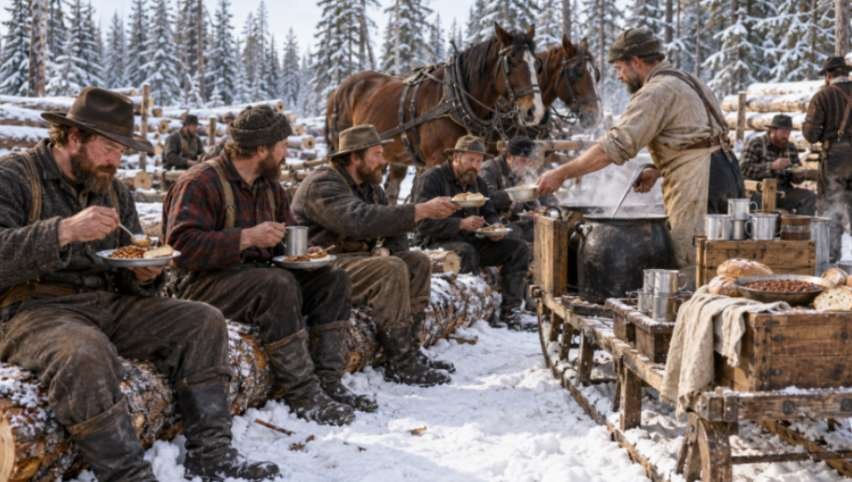
By the 1900s, progressive operations instituted the “flaggin’” system documented by the National Park Service. Cookees loaded insulated boxes of hot baked beans, fresh bread, and steaming kettles of tea onto horse-drawn sleds, driving the provisions straight to the cutting sites. Loggers ate on downed logs in fifteen minutes, stamped their feet to restore circulation, and returned straight to their axes.
| Meal Period | Core Menu Staples | Primary Fuel Source |
| Breakfast (5:00 AM) | Flapjacks (“sweet pads”), salt pork, fried potatoes, stewed prunes | Fast-acting carbohydrates & animal fats |
| Dinner/Lunch (Noon) | Navy beans with molasses, soda biscuits, salt beef, hot tea | Complex starches & slow-release proteins |
| Supper (6:00 PM) | Beef stew, boiled root vegetables, dried apple pies, donuts | Caloric replenishment & dense sugars |
Supper brought heavy roasts, sourdough loaves, barrels of baked beans, and endless rows of pies. Pastry chefs inside modern culinary institutions marvel at logging camp output: records preserved by Smithsonian Magazine note that a single camp cook and two cookees routinely baked twenty to thirty pies and hundreds of donuts every afternoon on wood-fired cast-iron ranges.
Table Jargon: From Lumber Shanty to the Modern Counter
The mandatory silence in the cook shanty catalyzed an efficient linguistic shorthand. Rather than conversing, men developed a lexicon of direct, descriptive nicknames for table staples to make requests immediate and distinct.
These dining practices were part of a broader tradition of communal dining in historic logging camps, where shared mess halls structured both work and mealtimes.
Loggers asked for “axle grease” when reaching for butter. Milk appeared as “cow juice,” while a shaker of salt was simply “gravel.” Prunes were tagged as “loggers’ plums,” and black tea was known as “swamp water.”
LUMBER SHANTY SLANG MODERN EQUIVALENT
“Axle Grease” ──► Butter
“Gravel” ──► Table Salt
“Cow Juice” ──► Whole Milk
“Loggers’ Plums” ──► Dried Prunes
“Sweet Pads” ──► Flapjacks / Pancakes
When loggers migrated into railroad towns and industrial centers during the spring river drives, this culinary shorthand migrated behind them into commercial grease traps. Short-order cooks rapidly adopted the same expressive code, establishing the foundations for common diner lingo that permeated twentieth-century roadside lunch counters.
Frequently Asked Questions
1. Why wasn’t talking allowed in lumber camp mess halls?
Silence prevented violent disputes among tired workers and forced men to eat rapidly so kitchen cleanup could begin.
2. How many calories did a 19th-century lumberjack eat per day?
Loggers consumed between 6,000 and 8,000 calories daily to endure grueling outdoor labor in sub-zero winter temperatures.
3. What was the Gabriel Horn in a logging camp?
It was an eight-foot tin trumpet blown by the cook to signal crews across the woods that a hot meal was ready.
4. What was a “belly robber” in lumberjack history?
“Belly robber” was an insult for an incompetent camp cook whose poor food drove crews to quit or strike.
The Final Bell: Reclaiming the Lost Art of Eating with Purpose
The strict rules of the lumber camp cook shanty look harsh through a modern lens, yet they built an efficient communal machine that fueled the timber boom of North America. Dining was stripped of pretense: you arrived hungry, honored the cook’s discipline, respected the working silence, and cleared the bench so the crew could keep moving.
The next time you enjoy a simple meal of pancakes or a bottomless cup of coffee at a roadside counter, pause for a moment to remember the cold-timber sawyers who turned mealtime into a quiet, focused art. Take a page from the shanty playbook: set your phone aside, eliminate the midday chatter, and give your food your undivided attention.