I spent three months last winter restoring a rusted 1954 Silk City diner car in central New Jersey. Between stripping warped linoleum and rewiring neon transformers, my favorite task was salvaging the counter fixture: a battered, cylindrical glass case with a seized internal motor.
Studying the history of pie display cases in american diners reveals that this was never just decorative glass. It was an intentional piece of kinetic theater. Diners turned dessert into an inescapable, mechanical sales pitch.
Before diners dominated roadside America, pie lived in a dark corner of the kitchen. Its journey to the center of the chrome counter required breakthroughs in tin ventilation, urban automation, and mid-century behavioral marketing.
[ 1800s Pie Safe ]
(Punched tin, passive airflow, domestic wood)
│
▼
[ 1900s–1920s Automats & Wagons ]
(Individual glass coin cubbies; visual temptation)
│
▼
[ 1930s–1940s Refrigerated Counter Cases ]
(Curved commercial glass, safe custards, impulse placement)
│
▼
[ 1950s Revolving Carousels ]
(Motorized 1-2 RPM turntables, 360° sightlines, Googie chrome)
The Rustic Precursor: Pennsylvania Dutch Pie Safes and Early Lunch Wagons
Pie was not originally restaurant food. In eighteenth- and nineteenth-century domestic kitchens, baking happened once or twice a week. Storing fruit, chess, and mince pies meant protecting them from insects, mice, and airborne spores without suffocating the crust.
Punched Tin and Passive Ventilation
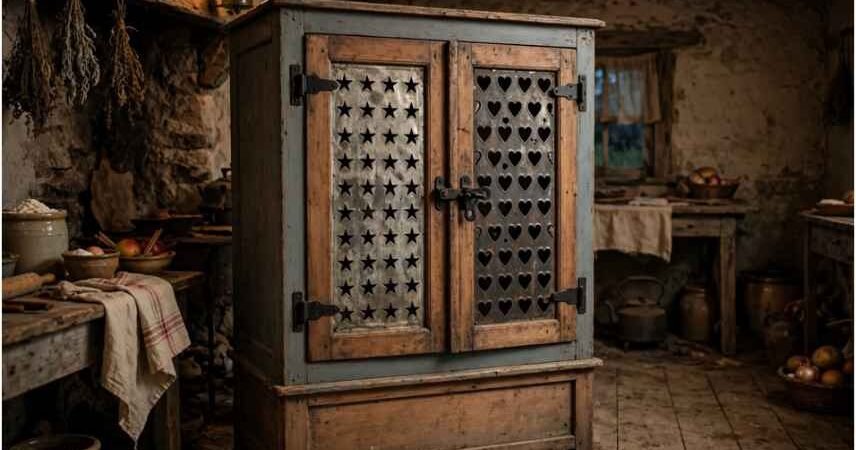
The true ancestor of the diner case is the freestanding wooden pie safe, popularized by German immigrants in Pennsylvania. These cabinets featured wood frames fitted with punched tin or zinc panels.
According to archival culinary records documented by the Smithsonian Institution, the small pierced holes served a dual physical role:
- They allowed hot steam and moisture to escape so bottom crusts stayed crisp rather than soggy.
- The tight punctures blocked larger pests and flies while keeping light levels low to slow oxidation.
These pieces were purely functional domestic furniture. Nobody was trying to market a pie; they were trying to survive the week before refrigeration existed.
The Automat Blueprint: Making Food Visual
When commercial eating establishments emerged in the late nineteenth century, pies followed. Walter Scott pioneered the horse-drawn night lunch wagon in Providence, Rhode Island, selling ham sandwiches and durable fruit pies to late-shift print workers.
His wagon kept pies under wooden covers or inside primitive iceboxes. You ordered blindly from a chalk slate.
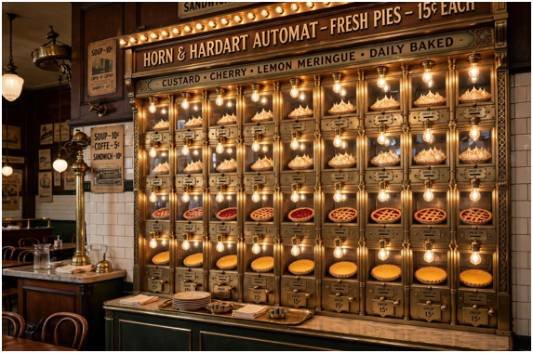
That invisible paradigm shattered in 1902 with the arrival of Horn & Hardart’s Automats in Philadelphia and New York. Historical urban planning archives preserved by the Library of Congress reveal how the Automat dismantled the counter barrier.
Automats featured gridded walls of brass and glass compartments. Customers saw the lemon meringue pie glistening beneath warm incandescent bulbs before inserting nickels into the slot.
This taught an entire generation of restaurateurs a fundamental psychological lesson: visibility drives appetite. If people see the meringue peaks, they buy the slice.
The Glass Countertop Shift: Refrigeration Meets High-Speed Merchandising
By the 1930s, lunch wagons had evolved into stationary, prefabricated steel buildings. The Great Depression and early wartime expansion catalyzed a major shift in public dining expectations: sanitation became a visible metric of quality.
+———————————————————–+
| EARLY 20TH-CENTURY AUTOMAT WALL |
| |
| +———–+ +———–+ +———–+ |
| | [Custard] | | [Cherry] | | [Meringue]| [Slots] |
| | (Glass) | | (Glass) | | (Glass) | (¢) |
| +———–+ +———–+ +———–+ |
| Coin Turn Coin Turn Coin Turn |
+———————————————————–+
Preserving Custards in Streamlined Chrome Diners
Two industrial milestones collided between 1930 and 1945:
- Affordable commercial electric refrigeration systems.
- Heavy-duty curved plate glass manufacturing.
Prior to reliable refrigeration, diners stuck to high-sugar fruit pies (apple, blackberry, cherry) that could sit safely at room temperature for days. Dairy-heavy custards, banana creams, and chiffon pies were risky in summer heat.
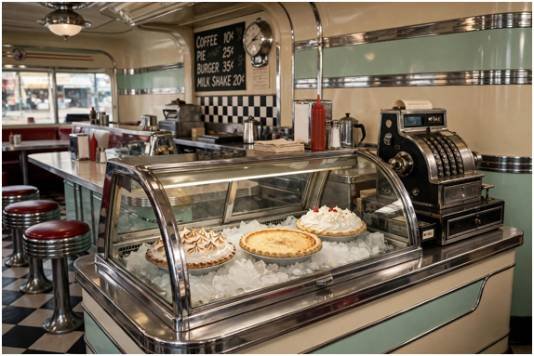
Built-in refrigerated display cases changed that equation overnight. Fabricators like the Jerry O’Mahony Diner Company built horizontal refrigerated display cases directly into the customer service counter, right next to the cash register.
These cases relied on polished stainless steel frames, thick rubber gaskets, and front-facing glass. Placing fragile cream pies on ice behind glass reassured diners that the kitchen was clean. It also transformed every bill-paying customer into an impulse buyer.
During this era, these spaces made a neighborhood restaurant a true third place, where counter patrons lingered over coffee and dessert long after finishing their meals.
The Golden Age: Anatomy of the Revolving Pie Carousel
The post-World War II boom reshaped diner architecture to cater to automobile culture. Diners installed soaring neon pylons, terrazzo flooring, and sweeping glass walls to capture motorists driving at 50 miles per hour, adopting structural conventions cataloged by the National Park Service Historic American Buildings Survey.
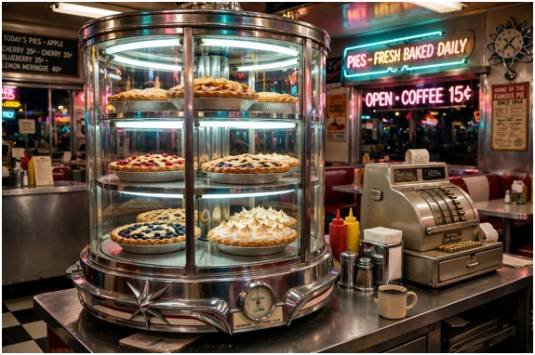
Inside, counter theater reached its absolute peak with the motorized, revolving vertical pie carousel.
Kinetic Marketing and the 45-Second Visual Loop
The countertop rotating pie tower exploited a foundational rule of human perception: peripheral vision defaults to motion.
When a customer sat on a chrome-mounted swivel stool to eat a burger, a stationary dessert case quickly faded into background architecture. A revolving case, however, maintained constant motion at eye level.
[ 1950s MOTORIZED CAROUSEL ]
┌─────────────┐
│ Top Motor │
├─────────────┤
│ [Plate 1] │ ◄── 1.5 RPM Rotation
│ ▲ │
│ [Plate 2] │ ◄── Interior Tube Lighting
│ ▼ │
│ [Plate 3] │ ◄── Tempered Glass Cylinder
└─────────────┘
The rotation created an unconscious countdown loop:
- A high slice of chocolate cream rotated into your direct field of vision.
- It lingered for roughly twelve seconds.
- It glided slowly out of view behind the opaque rear door, vanishing for half a minute.
This rotational cycle triggered an artificial scarcity reflex. Patrons watched the slice disappear, waited for it to reappear, and frequently ordered dessert before their main course was even cleared.
The Engineering Behind the Spin
While restoring that 1954 fixture, I disassembled its core drive assembly. These units were over-engineered mechanical appliances built for continuous daily operation.
+——————–+—————————————————–+
| Component | Specification & Historic Function |
+——————–+—————————————————–+
| Drive Motor | Low-wattage shaded-pole or synchronous AC motor |
| Rotation Speed | 1.0 to 1.8 RPM (calibrated to avoid cream slump) |
| Internal Lighting | T8 fluorescent tubes shielded in white diffusing acrylic|
| Glass Enclosure | 3/16-inch curved annealed or early tempered glass |
| Turntable Bearings | Heavy grease-packed thrust ball bearings |
+——————–+—————————————————–+
If the motor spun faster than 2 RPM, centrifugal force and vibration caused high meringue caps to weep and crack along the crust line. At 1.5 RPM, the motion was nearly silent and visually soothing.
The vertical tiers let diners merchandise five or six whole pies within an eight-square-foot counter footprint.
How Dessert Displays Transformed Diner Layouts
Integrating the pie carousel directly impacted broader restaurant design. Because the carousel required counter space and direct customer sightlines, it altered counter geography.
+———————————————————–+
| 1950s DINER COUNTER TOPOGRAPHY |
| |
| [Booth] [Booth] [Booth] |
| ───────────────────────────────────────────────────────── |
| [Stool] [Stool] [Stool] [Stool] [Stool] [Stool] [Stool] |
| ──────────────────────┐ ┌──────────────── |
| Main Service Line │ [PIE CAROUSEL] │ Cash Register |
| │ (High Eye-Line) │ (Exit Node) |
| ──────────────────────┴─────────────────┴──────────────── |
| OPEN PREP KITCHEN |
+———————————————————–+
Architects aligned the pie carousel along primary circulation vectors:
- The Payment Convergence: Operators positioned the case adjacent to the cash register station. If the server missed an upsell at the counter, the customer faced a rotating lemon meringue pie while waiting for change.
- Open Kitchen Sightlines: Diners placed pie cases directly along low divider walls separating the counter from the short-order grill. This preserved open kitchen sightlines while hiding utility wiring and secondary service tools.
- Community Focus: Gathering around a visible, shared showcase reinforced communal dining traditions, tying individual stool patrons into a shared culinary ritual.
Today, modern health codes and modular stainless kitchen designs have largely replaced mechanical carousels with horizontal refrigerated display cases.
Yet when you spot an authentic rotating cylinder humming softly on a vintage counter, you are not just looking at dessert—you are looking at mid-century commercial engineering at its finest.
Frequently Asked Questions
1. Why did old diners put pies in rotating cases?
Continuous movement caught the customer’s peripheral vision, turning dessert into an automatic visual upsell while saving horizontal counter space.
2. What is the difference between a pie safe and a diner pie case?
A pie safe was a ventilated, non-refrigerated wooden cabinet with punched tin panels, whereas a diner case used refrigerated glass and electric lighting to actively merchandise food.
3Did diner pie cases stay cold?
Early countertop cases relied on melting ice trays, but post-1935 diner models used built-in electric compression cooling to hold safe dairy temperatures.
Why did revolving pie cases disappear?
High maintenance costs for aging mechanical motors, stricter modern sanitation codes, and higher manufacturing costs for curved commercial glass pushed diners toward standard horizontal coolers.
The Final Slice: Keep Your Eyes on the Turn
The next time you slide into an authentic mid-century diner booth, skip the printed dessert menu.
Look directly toward the register station. If there is a glass tower humming quietly under fluorescent light, sit where you can watch the turntable spin.
Wait for the carousel to make two full passes before you choose: the best slice is always the one that catches the light right as it turns back toward the counter.