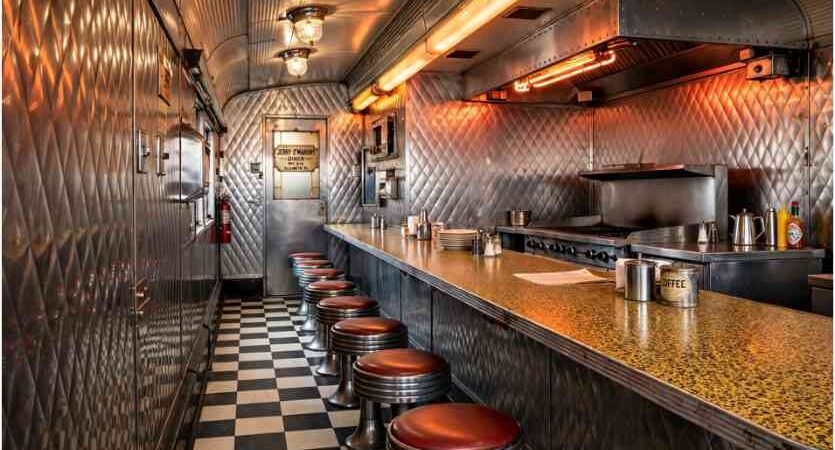
Step inside an untouched 1950s roadside diner and the metallic gleam hits you immediately. During my first structural survey of a 1948 Jerry O’Mahony dining car in New Jersey, I noticed that every square foot around the flattop cooktop was covered in cross-hatched, mirror-polished alloy. If you ever wondered why do vintage diners have stainless steel walls, the answer goes far beyond retro aesthetics. The wall cladding resolved fierce logistical challenges: modular road shipping, open-kitchen grease vapor, sanitation scrutiny, and tight spatial lighting.
The Rail Car Blueprint: How Transit Heritage Defined Diner Cladding
Diners never started as permanent brick-and-mortar buildings. They originated as mobile night lunch wagons rolled out in the late 1800s to feed nocturnal factory shifts. As manufacturers scaled up production in the 1930s and 1940s, they copied passenger rail car architecture.
Those streamlined locomotives, celebrated in exhibits preserved by the Smithsonian Institution Archives, relied on cold-rolled steel alloys for aerodynamic strength and effortless maintenance.
From Lunch Wagons to Modular Prefabrication
By the post-WWII boom, companies prefabricated complete diners in centralized East Coast assembly plants. Fabricators finished the interior wiring, installed the counters, and mounted spinning barstools right on the factory floor.
They built these units to emulate high-speed luxury trains, sparking the golden era of silver dining car restaurants along America’s expanding highway network. Cladding the walls in polished metal gave blue-collar patrons the feeling of traveling first-class on an express railway, even if they were just ordering a ten-cent cup of black coffee.
Road Hauling Limits and Structural Flexibility
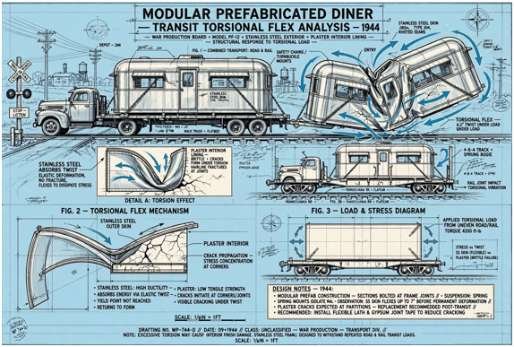
Diners traveled hundreds of miles on flatbed trucks and railway flatcars to reach their designated roadside plots. Traditional construction materials could not survive the trip. Plaster shattered over rough roads. Ceramic wall tiles cracked under frame torsion, popping grout lines within ten miles of transit.
Sheet metal solved this transport dilemma. Riveted and cleated stainless steel sheets flexed with the chassis during transit. The material held its ground across railroad crossings and potholes without a scratch.
+—————————————————————————–+
| STRUCTURAL MATERIAL COMPARISON IN MODULAR TRANSIT |
+———————-+——————–+———————————+
| Wall Cladding | Torsional Flex | Road Transit Failure Point |
+———————-+——————–+———————————+
| Plaster / Lath | Near zero | Cracks under frame vibration |
| Ceramic Tile / Grout | Rigid brittle bond | Grout powders; tiles pop loose |
| 304 Stainless Sheet | High elastic limit | Absorbs twist; zero degradation |
+———————-+——————–+———————————+
Cleanliness Theater: Sanitation and the Open Griddle
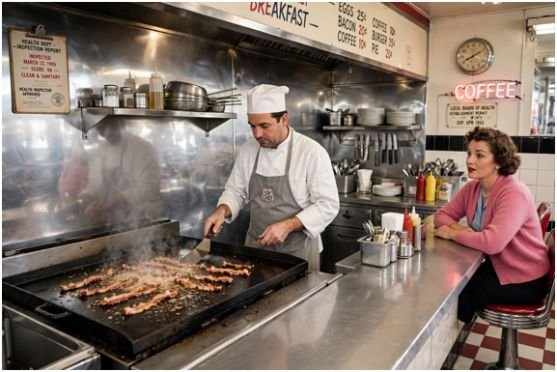
Diners pioneered the open-kitchen restaurant concept. In an era when dark saloon backrooms bred deep skepticism about food safety, diner operators flipped the script. They placed the griddle, sandwich boards, and rotating pie display cases in American diners directly in the customer’s sightline.
Non-Porous Surfaces and Health Inspector Standards
Because customers watched their bacon sizzle ten feet away, sanitation had to be absolute and visibly obvious. Wood paneling absorbs grease smoke, swells with humidity, and traps rancid kitchen odors. Plaster stains permanently after a few shifts of burger prep.
Austenitic stainless steel provided a dense, non-porous barrier against moisture, mold, and bacterial colonies. In fact, standard-setting bodies like NSF International built their commercial food-equipment certifications around smooth, cleanable stainless steels.
Diner cooks could scrub grease, vinegar, and hot brine across the metal with abrasive pads without pitting the underlying surface. The mirror finish proved to customers that the kitchen was spotless.
Thermal Deflection and Fire Safety Behind the Line
A 36-inch cast-iron commercial griddle generates intense radiant heat for twelve straight hours. Placing wood, gypsum board, or wallboard behind a line cook created a constant fire hazard.
Stainless steel sheets served as an impermeable thermal barrier. Backed with non-combustible transite or cementitious boards, steel deflected heat forward away from interior wall studs. It safely withstood bubbling oil splatter and grease fires without scorching or blistering.
The Mechanics of Quilted Metal: Why Flat Steel Failed
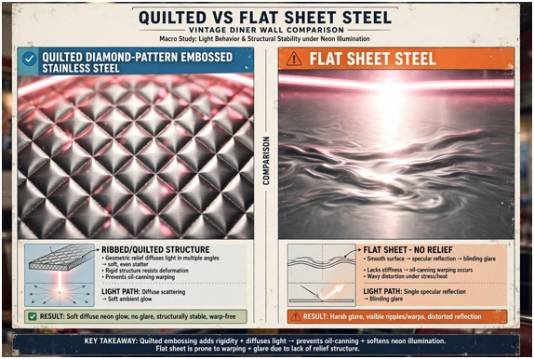
Look closely at classic diner kitchen backsplashes and you will rarely spot smooth, flat sheets. Instead, builders pressed diamond patterns, engine-turned swirls, or quilted ribs directly into the metal.
Preventing Oil-Canning and Thermal Warping
Thin sheets of flat stainless steel suffer from “oil-canning.” When temperatures fluctuate near hot cooking appliances, the sheet metal expands unevenly. This forms wavy ripples, buckles, and distracting visual distortions across the wall.
Stamping a quilted or diamond pattern introduces three-dimensional geometric rigidity into the gauge. The stamped creases function as micro-expansion joints. They absorb thermal stress without warping the sheet outward, keeping walls flat and secure against the framing.
Diffusing Neon Glare in Narrow Spaces
Highway department regulations constrained vintage diners to narrow widths, typically between 10 and 14 feet, so trailers could legally travel on regional roads. To keep customers from feeling claustrophobic inside a long metal box, designers used lighting to trick the eye.
Smooth sheet metal acts like a distorted mirror, throwing blinding hot-spots from overhead tubes and neon signage directly into diners’ eyes. Quilted, embossed, and engine-turned steel breaks up specular reflections. The stamped surfaces scatter ambient light softly around the room, making a narrow room feel twice as wide.
The Industrial Fabricators Who Made Chrome King
The golden age of steel cladding was led by dedicated New Jersey and Massachusetts manufacturers. Companies like the Worcester Lunch Car Company, Jerry O’Mahony Inc., Paramount Dining Car Company, and Silk City Diners turned prefabrication into an art form.
While early builders preferred rich mahogany and porcelain enamel, Paramount revolutionized the post-war market by building all-steel units. Many of these surviving treasures now appear on the National Register of Historic Places documented via the Library of Congress Historic American Buildings Survey. These master builders treated stainless steel not just as industrial armor, but as a signature style that outlasted the century.
Frequently Asked Questions About Classic Diner Architecture
1. Did retro diners use real chrome on their interior walls?
No, diners used 300-series stainless steel sheets on walls because chrome plating peels, blisters, and rusts over large cooking spaces.
2. Why do vintage diner walls feature a quilted pattern?
The quilted stamping prevents thin steel from warping under heat, hides surface scuffs, and diffuses harsh glare from neon lighting.
3. How did vintage diners keep their metal walls shiny?
Staff scrubbed the panels at every shift change using simple vinegar, warm water, and soda ash degreasers.
4. Are original mid-century stainless steel diners fireproof?
The exterior and interior metal skins will not burn, but structural timber frames and vintage roof decks still carried real fire risks.
Chrome Never Dies: The Verdict on Mid-Century Metal
The gleaming steel of an authentic American diner was never a decorative gimmick. It was a masterclass in industrial problem-solving. By wrapping narrow dining rooms in embossed steel alloys, builders solved fire codes, survived brutal cross-country highway deliveries, and built sanitation right into their interior design.
The next time you slide into an authentic booth, run your hand across the quilted metal behind the counter. That polished wall is a living artifact of mid-century engineering, built to survive millions of burger orders without losing an ounce of shine.