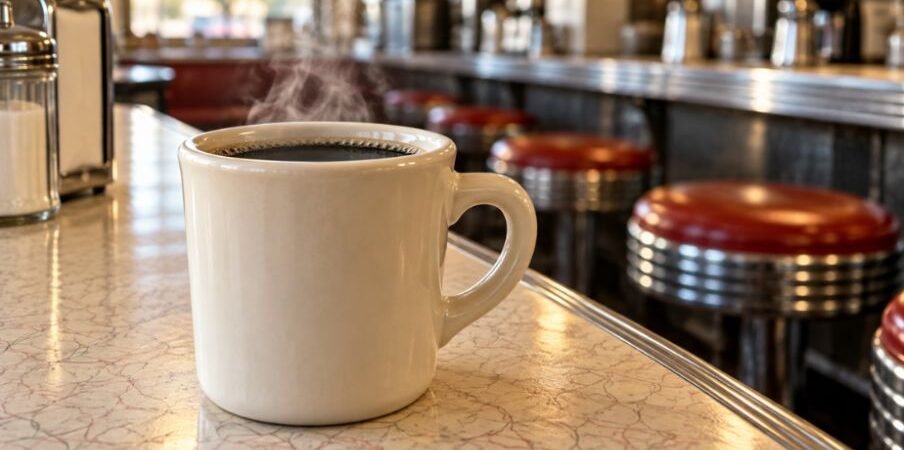
Slide onto a vinyl stool at any classic american diner counter, order a regular drip brew, and you instantly know the feeling: a mug that lands with a solid, reassuring thud. If you have ever wondered why do diners always serve coffee in thick ceramic mugs, the short answer comes down to extreme durability, heat-retaining thermal mass, and a forgotten piece of military engineering.
These heavyweight vessels were never chosen by accident; their design solved brutal logistical challenges on WWII warships long before they conquered American roadside restaurants.
┌──────────────────────────────────────────────┐
│ ANATOMY OF A CLASSIC DINER MUG │
└──────────────────────────────────────────────┘
Thick Rolled Lip ───┐ ┌─── Single-Finger “C” Handle
(Prevents chips) │ │ (Civilian post-war add)
┌──┴───┴──┐
│ █ █ │
Wet-Process Vitrified│ █ █ │◄── Heavy Ceramic Wall
Porcelain Body │ █ █ │ (Retains thermal mass)
│ █████ │
└───┬─┬───┘
│ │
Unglazed Foot Ring ─┴─┴─ Low Center of Gravity
(Frictional anti-slip) (Prevents counter spills)
I spent years working morning shifts behind greasy-spoon counters, slinging plates of hash browns and listening to the rhythmic clang of bus tubs. Thin, elegant porcelain cups would not survive three days in that high-turnover environment. Diner mugs are indestructible workhorses built to absorb punishment, insulate hot coffee, and feel grounding in your hand.
The Battleship Blueprint: How the Navy Engineered Your Coffee Cup
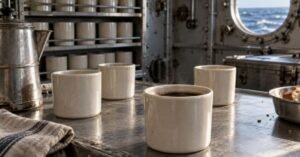
The story of the diner mug begins far from roadside neon signs. During World War II, the U.S. Navy faced an annoying, persistent problem: standard mess-hall cups shattered constantly and tipped over across slick tables during turbulent North Atlantic crossings. Metal restrictions also meant the armed forces needed alternatives to tin and enamelware.
The military turned to the Smithsonian National Museum of American History-documented industrial powerhouses of upstate New York. One supplier answered the call in an unexpected way: the Victor Insulators Company in Victor, New York.
From High-Voltage Poles to Mess Hall Tables
Victor Insulators did not make tableware. They manufactured heavy wet-process porcelain insulators designed to withstand high voltages on telephone lines and power poles. When naval contracts opened for break-resistant dishware, Victor’s engineers repurposed their industrial insulator molds.
Electrical porcelain required zero internal air pockets to prevent electrical arcing. That density meant the resulting mugs possessed unprecedented structural strength and ultra-thick walls. The military adopted them immediately.
[Electrical Insulators] ──> [WWII U.S. Navy Contract] ──> [Post-War Highway Diners]
Dense, air-free porcelain Handleless “Watch Mug” Added “C” handle & logos
The Reason the Original Navy Mugs Lacked Handles
The earliest naval versions—frequently called “watch mugs”—had no handles at all. They were tapered, heavy cylinders. This design served two critical functions at sea:
- Galley Storage: Without protruding handles, hundreds of mugs could be nested or slotted into compact galley racks without snapping under structural strain.
- Cold-Deck Hand Warmers: Sailors standing watch in freezing winds wrapped both palms directly around the thick porcelain cylinder, using the stored coffee heat as a personal defroster.
When service members returned home in the late 1940s, manufacturers like Victor and Buffalo China added durable, single-finger “C” handles to sell the mugs to civilian diners.
The Physics of Thermal Mass: Keeping the Bottomless Cup Hot
The thickness of a diner mug is often mistaken for simple insulation. In thermodynami

c terms, thick porcelain behaves as a thermal battery, drawing on principles studied by the National Institute of Standards and Technology.
Thin ceramic or single-wall glass cools rapidly because it has minimal thermal mass. Thick vitrified porcelain, however, absorbs heat energy from the freshly brewed coffee and stores it.
Once saturated, the mug’s dense walls slow convective and conductive heat loss to the surrounding ambient air. This extended heat retention makes the traditional “endless refill” model economically viable; customers drink coffee that stays within the optimal 135°F–150°F window far longer.
COOLING TRAJECTORY OVER 15 MINUTES (185°F Initial Pour)
Temp (°F)
185° ────┐
170° │ ═══════════════ Pre-Warmed Diner Mug (Stays in drinkable zone)
155° └───────────────
140° ──────────────── Thin Bistro Ceramic (Drops below ideal temp)
125°
0′ 5′ 10′ 15′
The Pre-Heating Ritual Behind the Counter
There is an operational catch to high thermal mass: physics works both ways. If you pour 195°F coffee into a stone-cold 15-ounce ceramic mug, the dense porcelain immediately leaches heat from the liquid, dropping its temperature by up to 15 degrees in seconds.
Good diner operators figured this out decades ago. Watch any seasoned counter server: the mugs are always stacked upside down on top of the commercial Bunn drip machine or parked on dedicated heated plate rails. Keeping the ceramic warm before the pour ensures that initial heat absorption never robs your first sip of its warmth.
Industrial Vitrification: The Unsung Hero of Diner Hygiene
Health codes in busy restaurants are non-negotiable. Commercial dishware must comply with sanitation standards like those outlined in the U.S. Food & Drug Administration Food Code. This is where companies like Buffalo China revolutionized the diner industry through vitrification.
Raw Clay Body + Feldspar Flux ──[Fired at >2200°F]──> Zero Internal Porosity (<0.5%)
- Bacteria-proof
- Stain-resistant
- High impact strength
During vitrification, kilns fire the clay at extreme temperatures exceeding 2,200°F, turning silica and feldspar into a non-porous, crystalline glass state.
- Microbial Defense: Porous earthenware absorbs liquids, developing micro-cracks where bacteria thrive. Vitrified porcelain absorbs less than 0.5% water, preventing trapped moisture.
- Stain Resistance: Years of acidic black coffee cannot penetrate vitrified porcelain, keeping mugs pristine even after thousands of cycles.
- Chemical Durability: Vitrified china survives aggressive commercial sanitizers and high-heat wash cycles without degrading its glaze.
Restaurant Counter Economics: Why Thin Porcelain Fails
Diners operate on razor-thin margins and furious turnover. Servers regularly bus tables by loading plastic tubs with heavy plates, silverware, and glassware.
| Feature | Classic Diner Mug (Vitrified China) | Standard Domestic Mug (Earthenware/Stoneware) | Thin Bistro Cup (Fine Porcelain) |
| Empty Tare Weight | 14 oz – 16 oz | 8 oz – 10 oz | 4 oz – 6 oz |
| Liquid Capacity | 7 oz – 8 oz | 11 oz – 14 oz | 6 oz |
| Vessel-to-Liquid Ratio | ~2:1 (Heavyweight) | ~0.7:1 (Standard) | ~0.8:1 (Lightweight) |
| Dishwasher Durability | High-impact industrial proof | Prone to rim chipping | Highly fragile |
| Center of Gravity | Low, wide base | Narrow / Variable | Elevated foot |
The 2:1 vessel-to-liquid weight ratio makes the diner mug uniquely sturdy. When you balance a 15-ounce empty mug against just 7 ounces of coffee, the vessel’s low center of gravity resists accidental elbow bumps in crowded booths.
This practical design was also part of the history of the classic American diner counter, where durable fixtures and equipment had to support fast-paced, high-volume service.
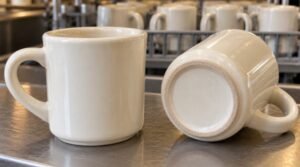
Flip the mug over, and you will spot another deliberate design feature: a rough, unglazed ceramic foot ring. When an espresso saucer or glazed cup hits a wet counter, it hydroplanes. The raw porcelain foot of a diner mug grips wet Formica, preventing costly slips and spills.
The Ergonomic Psychology of Heavy Ceramic
Beyond engineering and profit margins, there is an undeniable sensory appeal to the classic diner cup. The sensory feedback of dining equipment profoundly shapes customer perception.
This connection between physical dining spaces and shared eating experiences also reflects the communal dining traditions found in historic logging camps, where meals served as an important part of daily social life.
Holding a mug that weighs nearly a pound creates an intuitive impression of generosity and timeless permanence.
When staff rattle off common diner lingo like “draw one” or “cup of mud,” the heavy mug anchors the entire experience. The rolled, pillowy rim alters how the coffee hits your palate, tempering the sharper, bitter edges of dark-roasted robusta blends. It feels cozy, unpretentious, and uniquely American.
Last Call at the Counter: Pouring It All Out
The humble diner mug was never meant to be a delicate showpiece. It was engineered to keep naval watchstanders awake on stormy decks and built tough enough to survive rowdy roadside mornings. Its thick walls hold heat, resist busy kitchen drops, and provide that distinct, hefty comfort every time you pick it up.
Next time you take a seat at the counter and hear the dull clatter of heavy ceramic meeting Formica, hold the mug with both hands. You are gripping eighty years of American industrial design, built to outlast whatever you throw at it.
Frequently Asked Questions
1. Why do diner mugs feel so much heavier than home coffee mugs?
Diner mugs use dense, wet-process vitrified porcelain fired with thick walls to withstand commercial dishwashers and avoid chipping.
2. How much coffee does a traditional diner mug actually hold?
Classic diner mugs typically hold just 7 to 8 fluid ounces, which keeps coffee fresh through frequent, piping-hot refills.
3. Why do diner coffee mugs have an unglazed ring on the bottom?
The rough, unglazed base creates friction that prevents the mug from sliding or hydroplaning across wet countertops.
4. Why do some diner mugs have such small handles?
The classic single-finger handle dates back to post-war commercial molds, designed compactly to resist snapping off during heavy use.