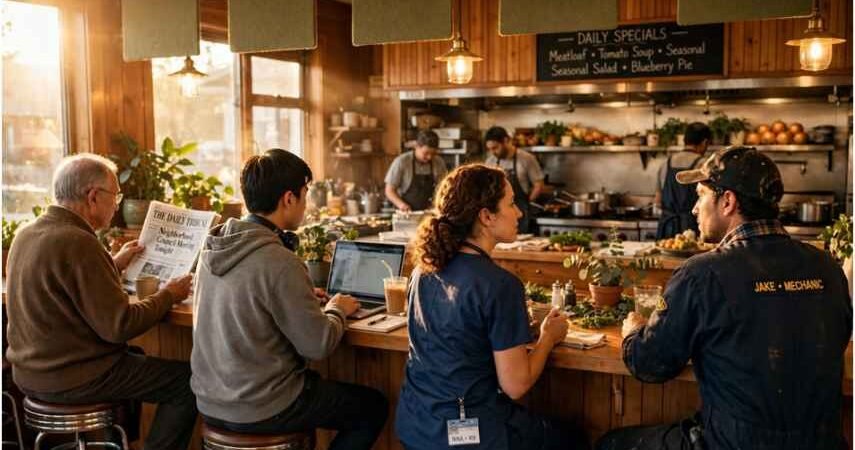
Most modern dining rooms are engineered like departure terminals: bright lights, loud surfaces, QR codes, and swift checks designed to clear your table in under forty-five minutes. When I sit at an authentic neighborhood spot, the emotional calculus flips entirely. The value shifts from rapid table turns to lingering human connection.
Understanding what makes a neighborhood restaurant a true third place requires looking past the menu and examining the social architecture that turns customers into a living community.
Sociologist Ray Oldenburg coined the concept in his 1989 landmark book The Great Good Place, which urban organizations like the Project for Public Spaces have long championed as vital civic infrastructure. Your first place is home. Your second place is work.
Your third place is the public anchor where you relax, converse, and connect without social or commercial performance. While libraries and parks offer municipal harbor, private establishments like diners, taverns, and corner cafés consistently cultivate the most resilient social bonds.
The Counter Over the Table: Architectural Anchors of Belonging
A true third place starts with intentional physical geometry. When you walk into an ordinary restaurant, host stands and high partition walls segment diners into private silos. Third-place hospitality does the opposite by designing for organic, accidental collision.
Rooted in historic communal dining traditions, these spaces welcome solo guests with open, non-territorial seating.
Why the Diner Stool Outperforms the Dining Booth
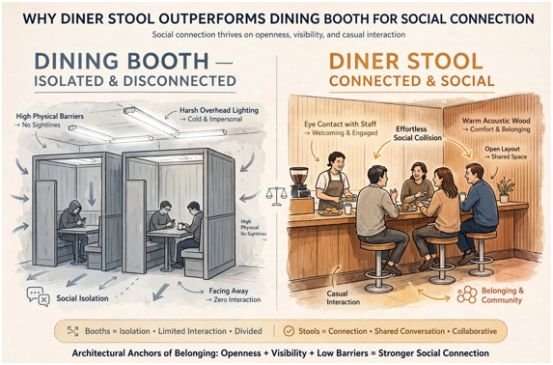
The classic swivel stool along an open counter remains the most egalitarian seating arrangement ever conceived. When I sit at a four-top table alone, I consume dead space and feel an implicit pressure from waiting parties.
At a diner counter, personal boundaries relax:
- Stools face forward toward open prep lines, so eye contact with staff is effortless.
- Turning ninety degrees to speak to a stranger requires no physical invasion of personal territory.
- The physical structure mimics the timeless evolution of 24 hour roadside diners, where weary travelers, off-duty nurses, and local mechanics sit side-by-side on identical chrome perches.
The acoustic profile matters just as much as the furniture. Third places deliberately avoid deafening music and cavernous, echoing concrete boxes. They use acoustic baffles, felt accents, and wood finishes to keep background decibels at a level where unforced dialogue can thrive.
Low Financial Friction as a Social Leveler
Oldenburg emphasized that a third place must serve as a leveler—an environment where socioeconomic status disappears at the entrance. In my consulting work with local cafés and neighborhood bistros, I have found that pricing is the ultimate gatekeeper.
If an entrée costs forty dollars and reservations require a deposit two weeks out, the venue becomes an exclusive destination, not a neighborhood anchor.
To function as a true community harbor:
- A low-cost menu anchor must always exist, such as an affordable bottomless batch brew, a modest house pint, or a staple cup of soup.
- A patron can visit three to four times a week without straining a modest household budget.
- The presence of an affordable anchor item protects the democratic ethos of the room, allowing higher-margin dinner specials to cross-subsidize communal lingering during off-peak hours.
The American Enterprise Institute documented that commercial venues like neighborhood diners often outperform public community halls at building diverse social networks. Affordable entry points turn incidental visits into dependable daily habits.
Front-of-House Staff as Civic Curators
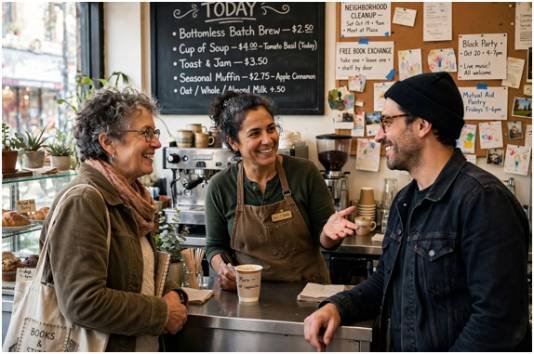
The physical space is merely a shell; the front-of-house staff supply the heartbeat. In an ordinary restaurant, servers are transaction handlers instructed to deliver plates and push up-sells. In a third place, staff act as neighborhood curators.
Long-tenured counter staff, baristas, and bartenders remember names, monitor the emotional climate of the counter, and build conversational bridges between solitary guests.
The Three-Visit Recognition Rule
During field evaluations of hospitality environments, I track guest retention through a simple milestone process:
- Visit One: Staff greet the newcomer with eye contact within fifteen seconds, noting basic beverage preferences.
- Visit Two: The team confirms familiarity by welcoming the guest back rather than asking if they have visited before.
- Visit Three: The server asks for the guest’s name, logs their usual order into memory, and connects them directly with a fellow regular.
This informal onboarding converts anonymous foot traffic into a cohort of protective regulars. As the Centers for Disease Control and Prevention highlights, consistent daily social connections mitigate the severe physical and mental health consequences of chronic loneliness.
Balancing Lingering With Unit Economics: The Generous Boundary
The fundamental problem with third-place restaurants has always been financial viability. How does an operator survive soaring commercial leases and rising payroll while encouraging patrons to sit for hours over a single mug of coffee?
The answer lies in an operational model I call The Generous Boundary. Rather than enforcing heavy-handed sixty-minute table limits or shutting off Wi-Fi entirely, sustainable operators implement clear daypart transitions.
Daypart Flexing and Off-Peak Square-Footage Yield
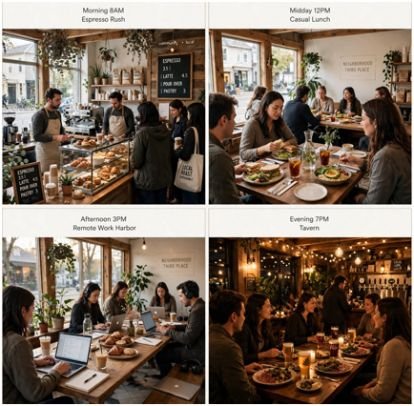
A third-place restaurant cannot rely on dinner seatings alone. Successful neighborhood anchors transition their layout and offerings across dayparts to maximize square-footage utility without rushing anyone:
| Time Block | Spatial Function | Dominant Revenue Stream | Lingering Policy |
| 7:00 AM – 11:30 AM | Morning drop-in, counter espresso, breakfast sandwiches | High-volume counter takeaway and solo bar seating | Unlimited counter lingering; light laptop usage permitted |
| 11:30 AM – 2:00 PM | Casual neighborhood lunch service | Full dining menu, daily lunch plates | Dining booths protected for dining; laptops migrated to counters |
| 2:00 PM – 5:00 PM | Remote work harbor, mid-afternoon teas, community meetings | Pastries, drip coffee, low-ABV drinks, pantry retail | Complete workspace hospitality; laptops welcome across communal benches |
| 5:00 PM – 10:00 PM | Evening tavern, dinner plates, craft beverages | High-margin evening plates, draft beer, natural wine | Laptops closed; dining booths prioritized for sit-down groups |
By monetizing the slow afternoon block through remote work harbor space and retail merchandise, operators absorb the financial cost of non-transactional lingering during quiet hours.
Frequently Asked Questions About Third-Place Dining
1. Can an upscale restaurant function as a third place?
Rarely, because premium pricing, reservation friction, and formal service codes prevent spontaneous, multi-weekly visits across mixed income levels.
2. How do third-place diners stop laptop users from occupying booths all day?
Operators restrict power outlets to communal bars, limit laptop use to off-peak afternoon windows, and gently steer solo workers away from large dining tables.
3. Why are diners better third places than public libraries?
Diners offer sensory stimulation, shared food rituals, and loud, unforced conversation that quiet library policies explicitly forbid.
4. What is the most important design element of a third place?
An accessible, linear counter where solo individuals can comfortably sit, eat, and chat without feeling isolated or rushed.
Reclaiming the Corner Table: Your Next Neighborhood Move
The soul of a city does not reside in its flagship architectural monuments or Michelin-starred temples. It lives in modest, unpretentious dining rooms where the server knows your name and nobody slides a receipt across the table the moment your fork hits the plate.
If you own an establishment, designate a communal counter, preserve an affordable menu anchor, and train your staff to introduce your regulars to one another. If you are a patron, stop hiding behind food-delivery delivery apps. Pick a local corner table, show up every Tuesday, tip generously, and claim your third place.