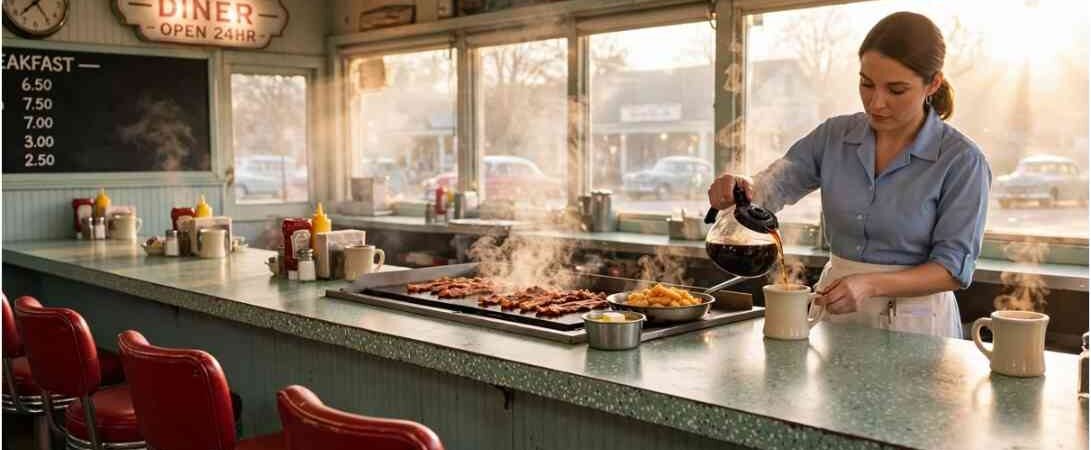
Pull up a swivel stool at 7:15 AM on a Tuesday, and the rhythm hits you immediately. The flat-top griddle sizzles with bacon grease, ceramic mugs hit Formica surfaces with rhythmic thuds, and the server slides a fresh cup of dark roast your way before you even open the laminated menu.
Yet when the check lands face-down beside your silverware, confusion often sets in. Is this counter service, like a modern fast-casual cafe where a digital tablet spins around with preset tip prompts? Or does it demand standard sit-down gratuity? Understanding tipping etiquette at diner breakfast counters requires recognizing that a stool is not an automated checkout line. It is a high-speed, full-service workstation.
The Breakdown: What to Tip at a Diner Breakfast Counter
At a traditional American diner counter, standard table service rules apply with one critical modification: a hard cash floor. Leave 15% to 20% of the total bill for standard service, and push to 22% to 25% for exceptional speed, continuous coffee warm-ups, or off-menu modifications.
The 20 Percent Benchmark vs. The $3 Base Floor
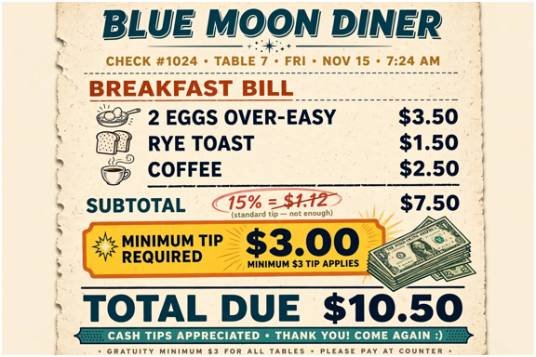
Percentage math falls apart on inexpensive diner breakfasts. If I order two eggs over-easy, buttered rye toast, and coffee, the bill might tally just $7.50.
A standard 15% tip on that check amounts to $1.12. Leaving barely a dollar leaves the server shortchanged. At that price point, the time and labor spent delivering butter, ketchup, water, and hot food match the effort required for a $35 steak elsewhere.
Always enforce the $3 minimum rule. If your total breakfast bill drops below $15, throw out percentage calculations entirely. Leave a flat $3 to $4 tip. That baseline keeps the server whole regardless of how cheap the kitchen prices its eggs.
The Bottomless Coffee Trap: Why Percentages Break Down
The classic diner bottomless cup of coffee is the ultimate hospitality bargain, running anywhere from $2.50 to $3.50. It is also the easiest way to accidentally undertip.
A 20% tip on a lone $3 cup of coffee is sixty cents. Yet that single order demands frequent check-ins, pot balancing, cream refills, and dirty dish clearing.
If you sit at the counter nursing three refills while flipping through the morning paper, leave at least $2 to $3 in tip money on that beverage alone. Base your gratuity on the attentiveness and physical presence of the server, not the price of the grounds.
The Stool Economy: Why Counter Service Isn’t “Fast Casual”
In recent years, the wide adoption of point-of-sale tablets has blurred the lines of gratuity. Many patrons conflate diner counters with fast-casual registers where you stand, order, bus your own tray, and clear your own trash. That assumption ignores how traditional diner spaces operate.
Proper counter seating etiquette at vintage diners is built on an understanding of seat utilization. When you sit at a diner counter, the server functions as your personal station captain, runner, and busser.
Table Turnover Speed and Hourly Earning Velocity
A booth seats a family of four and generates a $60 check over forty-five minutes. A single counter stool generates small, rapid tickets: $9 for pancakes, $12 for an omelet.
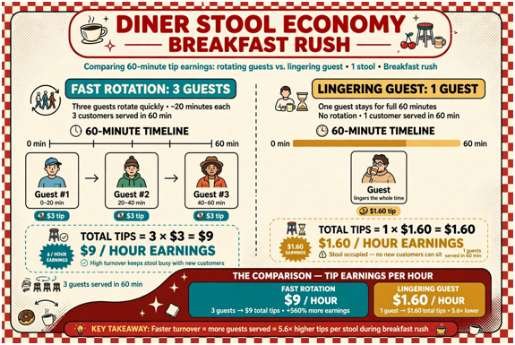
Counter attendants survive on velocity. If a stool turns over three times in an hour, the attendant collects steady incremental tips that assemble a liveable wage. The moment a guest lingers over an empty plate during peak morning rushes (7:00 AM to 9:30 AM), that velocity collapses. Occupying prime real estate without ordering food actively blocks that stool from generating revenue for the waitstaff.
Diner Stool Revenue Dynamics (Breakfast Rush Window: 60 Minutes)
Normal Velocity:
[Guest 1: 20 min | $11 Check | $3 Tip]
↳ [Guest 2: 18 min | $14 Check | $3 Tip]
↳ [Guest 3: 17 min | $9 Check | $3 Tip]
Total Server Earnings per Stool: $9.00 / hour
The Lingering Camper:
[Guest 1: 58 min | $8 Check | $1.60 (20% Tip)]
Total Server Earnings per Stool: 1.60/hour(Loss:-7.40)
Back-of-House Choreography: The Cook and the Counter Attendant
Diners feature an open-line floor plan engineered during the early twentieth-century prefabrication boom. Because the griddle sits ten feet from the counter, the server coordinates every order in real time with the short-order cook.
Behind the scenes, service distribution varies. Under U.S. Department of Labor FLSA tip credit rules, employers who take a tip credit against server base wages cannot allow non-tipped kitchen staff into the tip pool.
Counter staff often tip out bussers and dishwashers directly from their shift cash. Every dollar left on the counter trickles through the team keeping the dining car running smoothly.
Cash Under the Saucer vs. Register Terminals
Payment routing at vintage diners often confuses first-time guests. Some locations settle checks stool-side, while others direct you to pay a centralized register near the entrance.
If paying by card at a central register, confirm the terminal assigns your gratuity to the specific counter server who worked your section. If the register uses an unassigned generic tip jar, the front cashier or house pool may absorb it.
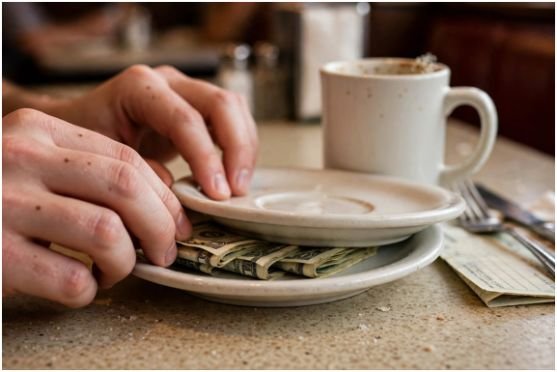
The gold standard remains physical currency. Fold crisp dollar bills and slide them firmly beneath the heavy rim of your ceramic coffee saucer or empty water glass. This physical anchor keeps paper money from blowing away when kitchen doors swing open, while visibly signaling to the attendant that their stool has been cleared and settled.
Long-Haul Dining: When to Tip 25 Percent or Higher
While standard service merits 20%, specific diner scenarios warrant a larger gratuity:
- Custom Short-Order Modifications: Asking the griddle cook for extra-crispy hash browns, egg whites cooked soft, and dry sourdough toast with sliced tomatoes on the side takes focused manual tracking during a rush.
- The Rainy-Day Camping Session: If you stay past your meal to read a novel, write, or wait out bad weather, add $1 to $2 for every extra twenty minutes you occupy the stool.
- The Off-Peak Regular: If the counter server remembers your exact order the moment you step through the door, reward that institutional memory. A generous tip supports the ongoing revival of retro diners as authentic third places.
Sassy Counter Sense: The Golden Finish
A diner counter is not an airport lounge, and it certainly is not a coffee shop co-working space. It is a working-class stage run on mutual respect, speed, and hot caffeine.
Respect the rhythm of the griddle, honor the labor behind that $4 short stack, and always keep a few dollar bills tucked in your wallet. When in doubt: tip 20%, never leave less than three bucks, and slide that cash under the saucer.
Frequently Asked Questions
1. What is the minimum acceptable tip at a diner breakfast counter?
Leave a flat minimum of $3.00, even if a standard percentage of your check comes out to pocket change.
2. Should I tip on a single cup of diner coffee?
Yes; leave $2.00 to $3.00 on a solo cup of coffee to compensate the server for refills, busing, and stool occupancy.
3. Do I tip the cashier or the server if I pay up front?
Leave cash under your counter saucer for the server, or ensure the register terminal specifies your server’s name on the card slip.
4. How much should I tip if I linger at the counter after finishing?
Add $1.00 to $2.00 for every additional twenty minutes spent occupying a busy counter stool after finishing your food.