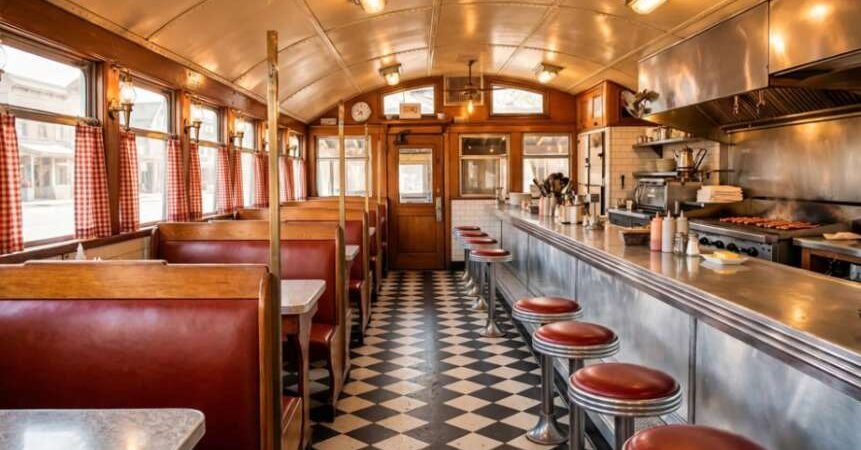
Taking a stool at a 1940s Silk City or Jerry O’Mahony dining car feels like stepping onto a living stage. The linoleum gleams, the flat-top griddle spits bacon fat, and the red vinyl swivel stool creaks under your weight. Yet, finding your place on that narrow chrome strip requires finesse. Understanding counter seating etiquette at vintage diners separates bewildered first-timers from the regulars who get their bottomless coffee poured before their jacket hits the under-counter hook.
Diner counters operate on high volume, compact architecture, and unvarnished social consideration. That proximity comes with an unspoken operating agreement designed to keep service moving and preserve personal space.
[ SHORT-ORDER GRILL LINE ]
========================================= <- The Chrome Service Rail (Keep Clear!)
( 1 ) ( 2 ) ( 3 ) ( 4 )
[STOOL] [EMPTY] [STOOL] [STOOL]
You Buffer Stranger Stranger
The Unwritten Geography of the Diner Stool
Vintage dining cars, documented extensively by architectural preservationists at the Smithsonian Institution, were prefabricated to mirror narrow railway dining cars. Because these historic footprints prioritize compact engineering over sprawling layouts, physical boundaries at the counter are exceptionally tight.
The One-Seat Buffer and the Solo Diner Reality
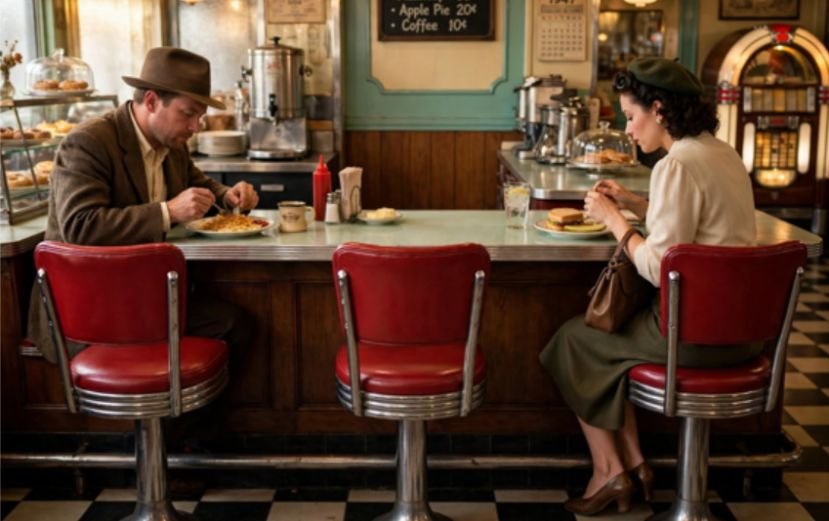
If you walk into a diner during an afternoon lull and see eight empty stools, never sit directly beside the lone patron hunched over their hash browns. The unwritten standard mirrors airport seating or restroom protocols: maintain a one-stool buffer whenever space allows.
Breaking this buffer when open seats surround you forces an unwanted social intimacy. That stool serves as an acoustic and spatial cushion. Only breach the buffer when the clock strikes 8:00 AM on a Sunday morning and a rush packs the doorway. When every seat fills up, slide onto any remaining stool without hesitation. That is how the room stays profitable.
Remember that counters belong to solo diners and twosomes. Dragging a party of four to the counter fragments workflow, blocks floor circulation, and creates an acoustic wall of conversation that drowns out order call-backs. If you arrive with a crew, wait for a booth.
Counter Territory: Protecting the Two-Inch Service Rail
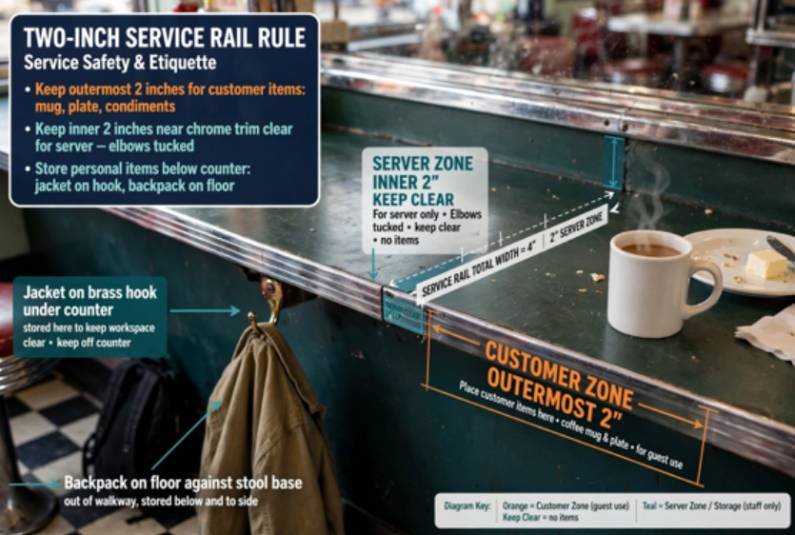
A diner counter is working commercial real estate, not an office desk. Most vintage counters measure a mere fifteen to eighteen inches deep.
Keep your elbows tucked into your sides while using your fork and knife. Flaring your arms crowds your neighbor’s perimeter and invites collisions with hot soup or coffee mugs. Stow all bulky personal gear immediately. Jackets belong on the brass hooks cast beneath the counter edge; backpacks and totes belong on the floor wedged against your stool base or resting directly on your lap.
The outermost two inches of the counter nearest your chest represent your dining boundary. The inner zone bordering the chrome trim belongs entirely to your server. Never clutter that inner rail with smartphones, sunglasses, or wallets. Your server needs unobstructed sightlines to slide plates of over-easy eggs and hot toast directly onto the surface without playing obstacle course with your valuables.
Communicating Across the Sizzle: Staff and Line Cook Protocols
The boundary between front-of-house hospitality and back-of-house manual labor shrinks to zero at a counter. You sit thirty inches from the spatulas, the orders called in diner lingo, and the sizzling scrapers. Navigating this dynamic requires knowing who to talk to—and when to remain quiet.
The Line Cook Glass Barrier
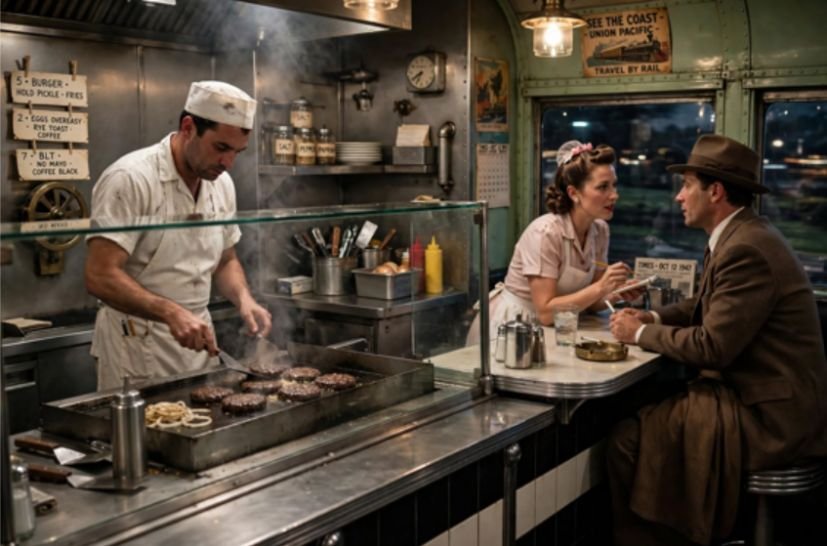
Even if you can make direct eye contact with the short-order cook searing your patty melt, never speak an order or modification across the stainless steel ledge.
Line cooks track tickets through precise mental queues, grease pencil marks, and ticket wheels. Shouting, “Could I get those onions extra crispy?” throws a wrench into a delicate timing puzzle. Treat the glass sneeze guard or stainless steel partition as an impenetrable wall. All requests—from an extra side of rye toast to a fresh water glass—must route through your server.
Keep casual banter measured. Seasoned counter workers pride themselves on friendly rapport, celebrated in food sociology coverage by Eater. However, when ticket slips back up and the fryer alarms chime, keep dialogue functional. State your order clearly, confirm your sides, and let the staff run the floor.
The Mug Pivot: Non-Verbal Bottomless Coffee Signals
Bottomless drip coffee is the bloodstream of any vintage diner. Waving your hands, snapping your fingers, or calling out across the dining car breaches every standard of counter decorum. Instead, rely on the “Mug Pivot.”
+——————————————————–+
| STEP-BY-STEP: THE MUG PIVOT |
+——————————————————–+
| 1. Assess Level: Reach the final 1/2 inch of coffee. |
| 2. Shift Position: Slide mug 2 inches forward. |
| 3. Turn Handle: Point handle outward toward server. |
| 4. Maintain Posture: Keep eating; do not flag staff. |
+——————————————————–+
An observant server scans counter sightlines constantly. An empty mug turned outward acts as a visual beacon. They will glide by with a glass pot, refill the mug in one fluid motion, and keep moving. If you do not want a refill, leave your mug half-full or invert your spoon across the rim.
Pacing Your Meal on the Formica Line
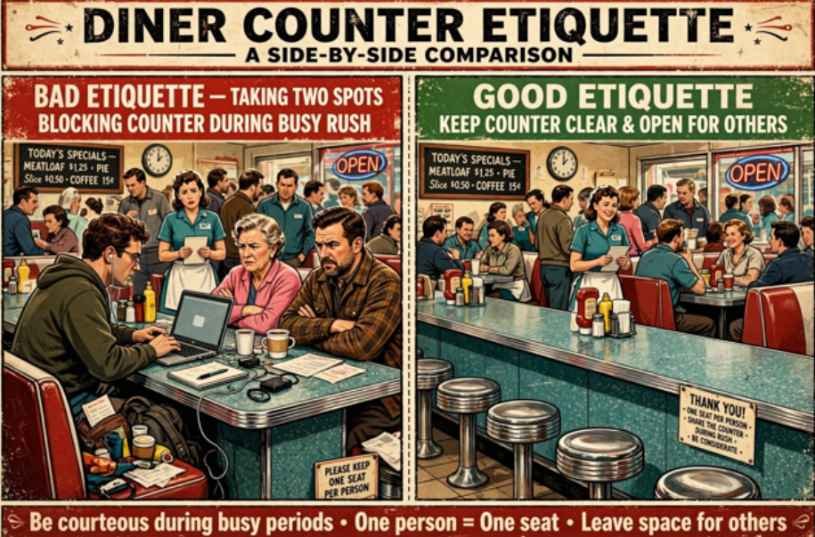
The business model of a historic diner rests squarely on velocity. Unlike European-style cafes engineered for hours of idle reading, dining car counters depend on steady seat turnover to pay utility bills and tip out floor workers.
Avoiding the Laptop Trap at a Greasy Spoon Restaurant
Working remotely from a stool at a busy greasy spoon restaurant is a fundamental faux pas. Laptops, notebooks, and charging bricks do not belong on grease-resistant Formica.
Diner culture centers on sensory engagement: the clatter of heavy mugs on saucers, the aroma of griddled onions, and brief, democratic neighborliness with folks from every walk of life. Spreading paperwork across two placemats robs a working-class institution of its rhythm. If you finish eating and intend to read or scroll on your phone, monitor the waiting area behind you. The second customers queue up near the entryway, wrap up your meal.
Historic institutions, like those chronicled in the James Beard Foundation American Classics archives, survived decades by serving meals fast and moving patrons along cordially. Honor that heritage by treating your stool as a pit stop rather than a private living room.
Settling Up: The Register Slide vs. Counter Pay
When your server sets the check down, read the room before reaching for cash or plastic.
- The Register Walk: If you spot an antique mechanical register or a modern point-of-sale terminal positioned near the front exit door, take your paper receipt and pay up front on your way out.
- The Counter Drop: If the server places the bill facedown alongside a pencil or asks if you need change while standing before you, settle the bill right on the counter.
Never leave loose change or crumpled bills swimming in puddles of spilled water or maple syrup. Anchor paper currency firmly beneath the salt shaker or the lip of your empty coffee saucer so drafts from swinging entry doors do not blow your tip onto the floor.
Slide Out Like a Pro
The beauty of a vintage diner counter lies in its egalitarian simplicity. It is one of the rare places in modern life where CEOs, transit workers, travelers, and retirees share the same strip of polished chrome to enjoy eggs and hash browns.
That shared social role is part of what makes a neighborhood restaurant a true third place, where people can gather, connect, and feel part of a community beyond home and work.
Respect the server’s workspace, guard your neighbor’s elbow room, and keep the coffee signals sharp. Once your plate is clear and the bill is settled, slide off the stool and pass the seat to the next hungry patron.
When you sit at a classic american diner counter, you trade the insulation of a vinyl booth for front-row communion with the grill.
Frequently Asked Questions
1. Can I sit at an open counter stool if dirty dishes are on it?
Yes, take a seat, but do not touch or stack the plates yourself; let the server clear and sanitize the space.
2. Is it acceptable to ask for a separate check at the counter?
Yes, but request split checks when ordering so the server can track tickets on separate slips from the start.
3. How much should I tip at a diner counter?
Tip a minimum of 20%, or at least three to four dollars on low-cost checks where percentages fail to reflect real labor.
4. Can I save a counter stool for a friend who has not arrived?
No; counter seats operate on an immediate-arrival basis, so wait by the door until your entire party enters the diner.