Pull off Route 66 at 2:15 AM, and the buzz of vintage argon gas hitting a glass tube still cuts clean through highway exhaust. You slide into a cracked vinyl booth, hear grease hissing across seasoned carbon steel, and the mug arrives filled before you speak. The evolution of 24 hour roadside diners is the real story of how working-class night shifts built modern American travel culture.
These roadside outposts evolved from makeshift horse-drawn wooden carts into hyper-engineered stainless steel beacons that fed a nation on wheels.
The Midnight Horse Wagons of Industrial New England
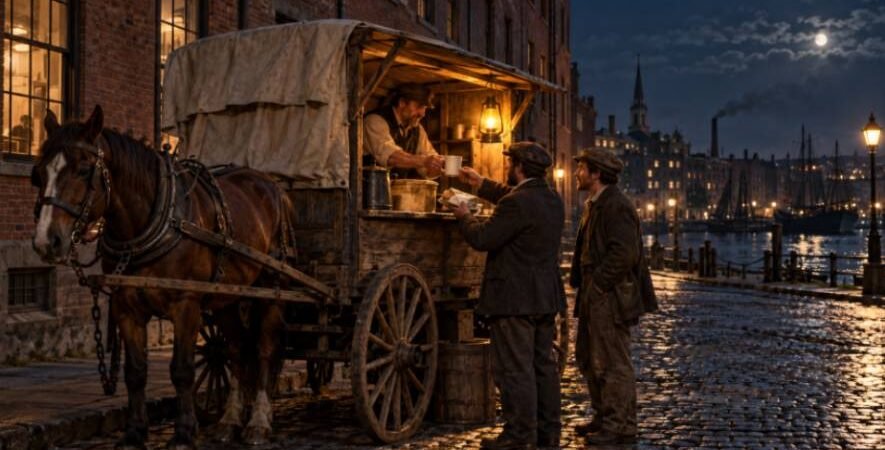
Late-night dining began with a gap in the municipal clock. In the late 19th century, city ordinances across New England forced sit-down restaurants to shutter by 8:00 PM. Third-shift factory workers, typesetters, and rail switchmen had nowhere to buy a hot meal.
Walter Scott and the Providence Night Owl Model
In 1872, an enterprising pressman named Walter Scott realized the street held an untapped customer base. Scott retrofitted a covered freight wagon in Providence, Rhode Island. He parked outside the Providence Journal offices, dispensing hard-boiled eggs, buttered rolls, hot chicken sandwiches, and black coffee out of wicker baskets.
According to archival reporting by the Smithsonian Magazine, commercial carriage builders quickly took note. Companies like the Worcester Lunch Car Company began manufacturing custom-built “lunch wagons fitted with basic interior shelves and ice compartments. Municipalities restricted where wagons could stop, forcing operators to work exclusively between dusk and sunrise. Locals affectionately dubbed these roving outposts “Night Owls.”
From Retired Streetcars to Modular Steel Architecture
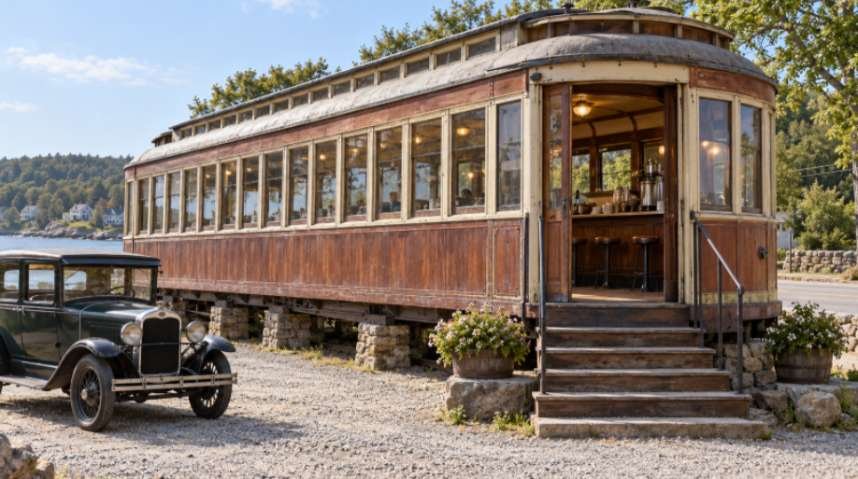
As cities electrified their public transit during the 1910s and 1920s, transit authorities auctioned off hundreds of decommissioned wooden horse-drawn streetcars. Savvy lunch wagon operators bought them for salvage rates, dragged them onto empty lots, and mounted them on cinder blocks.
These converted trolley cars dictated diner geometry: long, narrow footprints built around a single service aisle. As diner construction evolved from converted vehicles to purpose-built structures, why do vintage diners have stainless steel walls became a practical question tied to durability, sanitation, and easy maintenance.
By 1913, manufacturers began fabricating stationary, prefabricated steel diners from scratch. Owners could order a fully plumbed, pre-wired eatery from a catalog, ship it via flatbed railcar to an empty highway plot, and open within 48 hours.
The Postwar Interstate Boom and Stainless Steel Supremacy
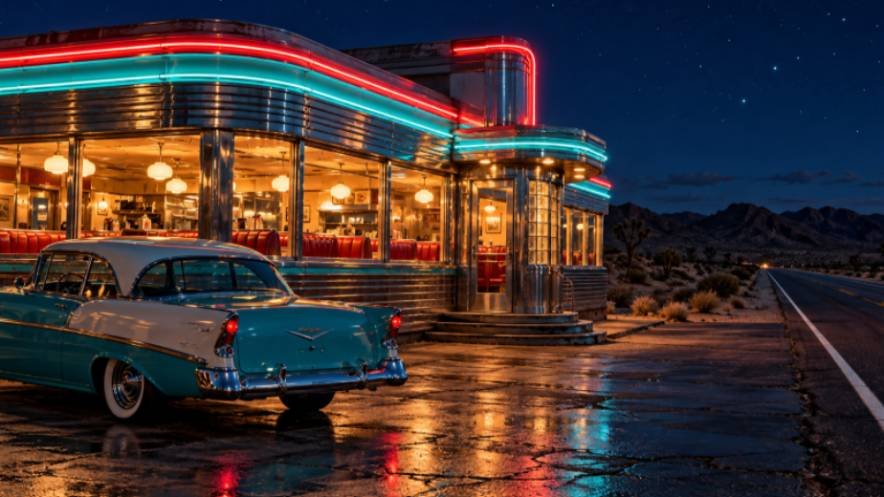
When the Federal-Aid Highway Act broke ground on thousands of miles of high-speed pavement, roadside businesses faced a new challenge: drivers cruising at 60 mph had only seconds to decide where to stop. Diner design became an exercise in industrial signage.
Streamline Moderne Engineering Meets 18-Minute Seat Turnover
Diner architecture adopted the Streamline Moderne and Art Deco styles championed by industrial designers. Exteriors shed their rustic wooden siding for mirror-polished stainless steel, ribbed porcelain enamel, and cantilevered neon rooflines that bounced headlights straight back at motorists.
The Library of Congress maintains detailed architectural surveys documenting these structures as vital artifacts of mid-century industrial manufacturing.
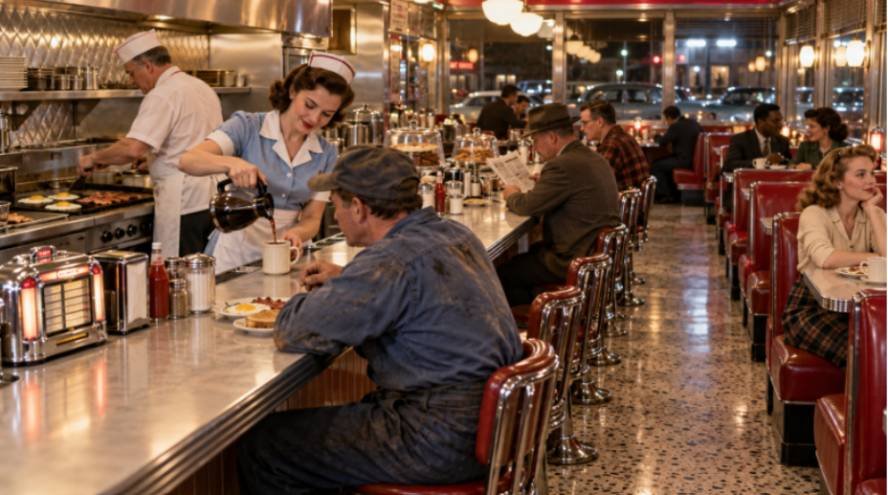
Inside, the layout prioritized rapid turnover. The heart of the floor plan was the classic american diner counter, featuring swivel stools bolted directly into terrazzo floors:
| Station Feature | Functional Purpose | Operational Impact |
| Monel & Stainless Counters | Impervious to boiling grease; sanitizes in seconds | Reduced clean-up between seatings to under 45 seconds |
| Formica Laminate Tops | Non-porous surface resistant to cigarette burns | Cut daily maintenance expenses for high-traffic joints |
| Individual Table Jukeboxes | Kept booth guests entertained without central speakers | Encouraged coin spend while maintaining a quiet cooking line |
| Short-Order Griddle Rail | Placed cook directly facing the stools | Enabled cooks to take orders and drop eggs simultaneously |
During peak rushes, counter staff tracked an informal standard of counter seating etiquette, clearing spent plates the instant cutlery dropped. In my field notes tracking preserved diners across the Rust Belt, the math holds true: an 18-minute counter cycle turned three paying customers per stool every hour. That velocity generated sufficient cash flow to cover the high overhead of staying lit through dead night hours.
The Immigrant Kitchens That Built 24-Hour Menus
The legendary all-day menu was largely engineered by immigrant entrepreneurs, particularly Greek-American families who bought up roadside diners throughout New York, New Jersey, and Pennsylvania during the 1940s and 1950s.
These operators transformed simple breakfast carts into massive culinary operations. They introduced moussaka and spanakopita alongside meatloaf and club sandwiches. Crucially, they mastered the high-margin, low-waste prep of eggs, potatoes, and griddled meats. Drivers could order a Western omelet at 3:00 PM or a roast turkey dinner at 3:00 AM without the kitchen skipping a beat.
The Corporate Fast-Food Squeeze and Menu Bloat
By 1965, round-the-clock diners accounted for roughly 10% of commercial dining establishments in the United States, supported by massive auto travel tracked by the Bureau of Transportation Statistics. However, corporate efficiency was already drafting behind them.
Ray Kroc and the McDonald brothers dismantled the diner model by stripping labor costs down to the bone. Drive-thru lanes eliminated waitstaff, paper wraps made dishwashers obsolete, and limited nine-item menus drove inventory costs far below what an independent 24-hour kitchen could manage.
Independent diners reacted by doing the opposite: expanding their menus into 12-page encyclopedias. Trying to stock fresh seafood, prime rib, Italian pasta, and breakfast staples simultaneously strained prep lines and thinned profit margins. Thousands of independent diners shuttered between 1970 and 1990 as highway travel centralized around chain-dominated off-ramp plazas.
Why the 24-Hour Diner Clock Stopped Ticking Post-2020
The shift away from true 24-hour operations is not simply a matter of shifting consumer taste; it is a financial reality.
Historical data published by the National Restaurant Association outlines sharp post-pandemic rises in commercial labor rates, wholesale food costs, and commercial utility bills. Operating a kitchen between 1:00 AM and 5:00 AM requires a full line: a short-order cook, a dishwasher, and a server.
If the graveyard shift yields fewer than 18 covers an hour, utility and labor costs quickly outweigh ticket revenue. Consequently, iconic operators across the country cut their graveyard shifts, pivoting to high-density breakfast and lunch windows instead.
Preserving America’s Living Vintage Relics
Despite modern economic pressures, surviving vintage diners maintain cultural resonance precisely because they cannot be replicated by automated drive-thrus or sterile third-wave cafes.
Stepping into an original Worcester or Jerry O’Mahony car reminds us that these were democratic spaces. Long-haul truckers, midnight shift nurses, local mechanics, and weary vacationers all share the same counter space, bound by the universal comfort of bottomless hot drip coffee. Surviving diners stand today not merely as eateries, but as functioning museums of mid-century freedom, architecture, and resilience.
Frequently Asked Questions
1. What was the first 24-hour roadside diner in America?
Walter Scott’s 1872 horse-drawn lunch wagon in Providence, Rhode Island, established the commercial blueprint for around-the-clock roadside meal service.
2. Why were classic diners made of stainless steel?
Stainless steel resisted grease, required minimal exterior repainting, and projected a sanitary, Streamline Moderne aesthetic visible to fast-moving highway drivers.
3. Why did diners have long, narrow layouts?
Early diners were converted from decommissioned streetcars or built off-site to fit narrow flatbed railcars for roadside transport.
4. Why are so few diners open 24 hours today?
Post-2020 labor costs, rising wholesale food prices, and lower overnight foot traffic make the 1:00 AM to 5:00 AM shift unprofitable for independent operators.
Leave the Booth, Keep the Receipt: Your Next Roadside Run
Finding an authentic, fully operational roadside diner requires skipping interstate chain corridors and hunting state highways with two-digit names. Look for barrel-roof silhouettes, original porcelain tiles, and a parking lot populated by both fleet pickup trucks and highway cruisers. Order the corned beef hash, keep your elbows off the counter until your mug lands, and always tip the short-order cook.