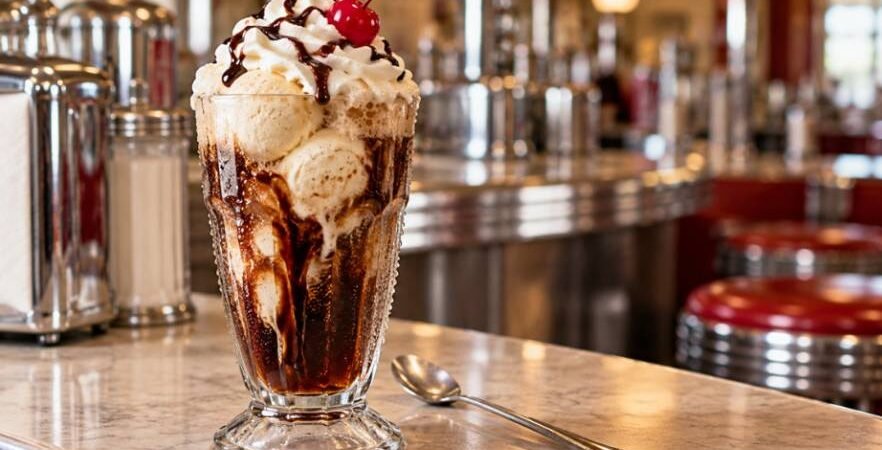
A true homemade black cow root beer float delivers a deep, velvet creaminess that flat, watery sodas cannot duplicate. When chocolate syrup meets spiced root beer and dense vanilla cream, the sharp botanical bite softens into pure nostalgia. I spent years ordering sad, over-foamed versions at roadside diners before dialing in the exact glass temperature and pour angle in my own kitchen.
Understanding how the chocolate base anchors the soda changes everything about this fountain staple.
What Is a Black Cow Root Beer Float?
The modern palate often confuses any soda-and-ice-cream pairing with a generic float. A Black Cow stands apart because it introduces rich cocoa solids directly against dark soda, building a luxurious, layered dessert.
The 1893 Cow Mountain Origin
Legend places the birth of this drink in Cripple Creek, Colorado, on August 19, 1893. Frank J. Wisner, owner of Cripple Creek Brewing, looked out at the moonlit, snow-dusted peak of Cow Mountain. The white cap over dark rock inspired him to drop a scoop of vanilla ice cream into Meyers Avenue Red Root Beer.
Wisner named his creation “Black Cow Mountain,” which soda jerks soon trimmed to the Black Cow. Historical beverage archives at the Library of Congress trace how late-19th-century American soda counters rapidly adopted these combinations, transforming medicinal carbonated tonics into community dessert staples.
Black Cow vs. Standard Float vs. Brown Cow
Regional soda fountain terminology fractured dramatically over the 20th century:
| Feature | Standard Root Beer Float | Classic Black Cow | Midwest Blended Cow | Brown Cow |
| Primary Soda | Root Beer | Root Beer (or Cola regionally) | Draft Root Beer | Root Beer / Cola |
| Ice Cream | Vanilla | Vanilla Bean | Vanilla Custard | Chocolate or Vanilla |
| Chocolate Element | None | Dark Chocolate Syrup | Blended into base | Chocolate Ice Cream |
| Texture | Separated layers | Pockets of fudge & foam | Semi-blended milkshake | Creamy suspension |
Traditional root beer draws its complex, medicinal backbone from wintergreen, birch, licorice root, and historical sassafras, which Encyclopaedia Britannica notes provided early American brews with their earthy punch.
Commercial bottlers transitioned to safrole-free flavorings after mid-century regulations from the US Food and Drug Administration (FDA) altered commercial extractions. Adding dark chocolate syrup cuts the pungent methyl salicylate in wintergreen, balancing the glass.
The Food Science Behind a Perfect Float Head
Most homemade floats fail due to aggressive fizzing that collapses into watery slush within two minutes. Making a restaurant-quality float requires controlling basic beverage physics.
POOR METHOD (Violent Eruption) PROPER METHOD (Micro-Foam Cap)
Warm Glass + Warm Soda Frosted Stein (-10°C) + 45° Wall Pour
+ Low-Fat Aerated Ice Cream + 14% Butterfat Dense French Vanilla
| |
v v
Rapid Nucleation -> Gas Lost Controlled Degassing -> Stable Emulsion
Icy, Grainy Surface Slush Dense, Velvet Foam Dome
Managing Nucleation Sites and Carbonation
Carbon dioxide sits dissolved under pressure inside bottled soda. Pouring room-temperature soda straight over cold ice cream creates violent thermal shock. The microscopic air pockets on rough ice cream act as nucleation sites, triggering rapid degassing. The soda boils over, sheds its carbonation instantly, and leaves flat syrup behind.
To solve this, temper the pour. Pouring cold soda along the tilted interior glass wall minimizes mechanical turbulence, letting the foam build a stable micro-foam cap rather than an uncontrollable eruption.
Butterfat Content and Thermal Shock
Never use budget “frozen dairy dessert” for a Black Cow. Low-fat, high-overrun products contain excess churned air and water. When soda hits water ice crystals, it freezes them into jagged, crunchy ice chips.
Always select super-premium vanilla bean ice cream with at least 14% to 16% butterfat and low overrun. The dairy fats act as an insulator, resisting rapid melting while emulsifying with the soda bubbles into a thick mousse.
Essential Ingredients for an Authentic Build
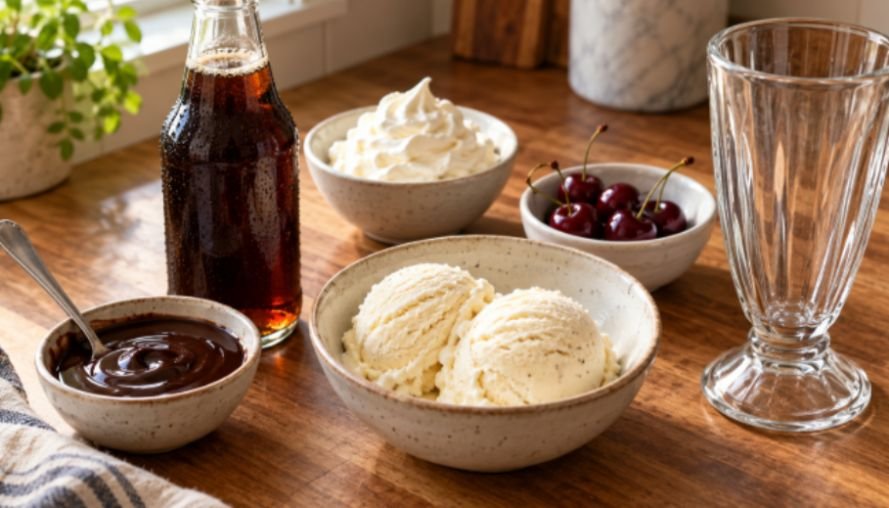
Quality components dictate the final flavor:
- Craft Root Beer (12 oz): Choose cane-sugar sodas over high-fructose corn syrup brands. Microbrewed options deliver real vanilla extract, anise, and birch oil that blend seamlessly with chocolate. Keep bottles refrigerated below 38°F (3°C) for at least four hours.
- Super-Premium Vanilla Ice Cream (2 large scoops): Seek out real ground vanilla bean or rich French custard varieties.
- Dark Fudge Sauce or Artisan Chocolate Syrup (2 tbsp): Avoid artificial, watery chocolate syrups. Use a thick chocolate sauce made with Dutch-processed cocoa and pure cane sugar so it sticks to the chilled glass.
- Finishing Garnish: Freshly whipped heavy cream (unsweetened or lightly vanilla-scented) and an Italian Amarena or stem-on maraschino cherry.
Step-by-Step Homemade Black Cow Assembly
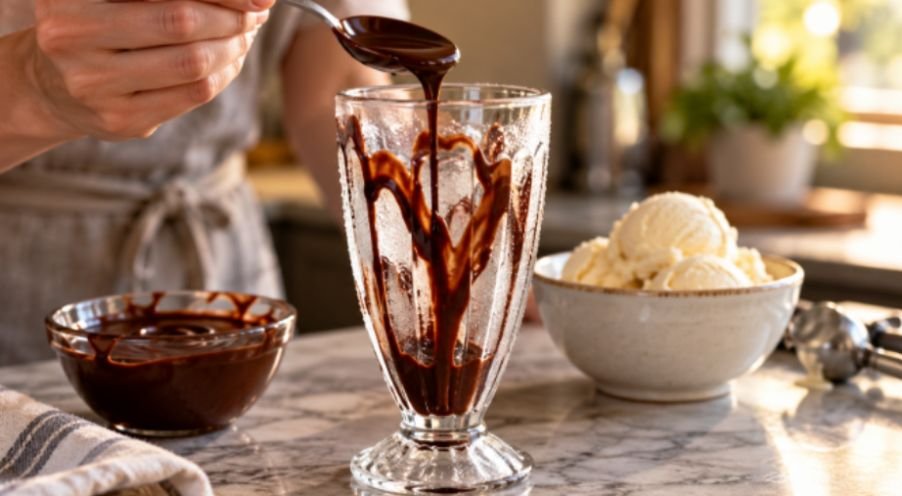
- Frost the Stein: Place a heavy glass mug or fountain soda glass into your freezer for 15 minutes. The frosted wall prevents immediate temperature exchange when soda hits the glass.
- Lay the Chocolate Foundation: Drizzle one tablespoon of dark chocolate syrup along the inside walls and floor of the frosted mug. The cold glass causes the syrup to seize slightly, forming thick ribbons that will not instantly dissolve.
- Seat the Dairy: Firmly roll two dense scoops of vanilla bean ice cream. Drop them squarely into the bottom of the glass. Pressing them down gently eliminates large trapped air gaps beneath the scoop.
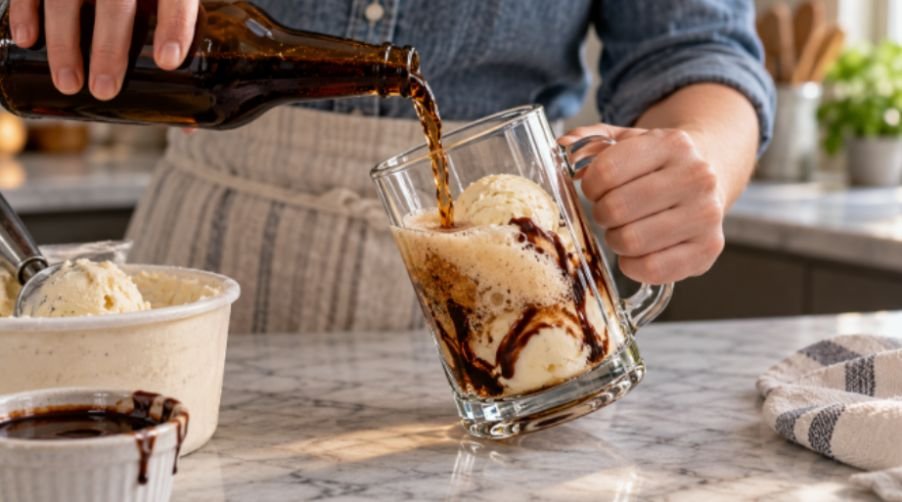
- Execute the Angled Pour: Tilt the stein at a 45-degree angle. Crack your chilled root beer bottle and pour steadily against the glass wall. Fill to two-thirds capacity, pause for ten seconds to let the initial head consolidate, and top off gently.
- Crown and Serve: Add a deliberate swirl of hand-whipped cream, thread a thin ribbon of chocolate over the peak, and set a cherry on top. Serve with both a wide-bore straw and a long soda spoon.
Soda Fountain Twists and Botanical Pairings
Once you master the standard technique, explore woodsy and botanical profiles. Much like balancing smoke and sweetness in a smoked cedar plank cocktail.
For another cozy chocolate drink with a bolder, fireside-inspired character, try this spiked hot chocolate variation.
Swap standard chocolate syrup for a cocoa nib reduction infused with charred wood bitters, or use spiced Mexican chocolate syrup containing cinnamon and dried ancho chile.
These earthy notes complement root beer’s botanical sarsaparilla base, turning an ordinary diner dessert into an elevated tasting experience.
Frequently Asked Questions
1. What makes a Black Cow float different from a regular root beer float?
A Black Cow incorporates rich chocolate syrup or chocolate ice cream, whereas a standard float relies solely on vanilla ice cream and soda.
2. Can I make a Black Cow using Coca-Cola instead of root beer?
Yes, many historic southern and central diners make a Black Cow exclusively with Coca-Cola.
3. Why does my ice cream float turn icy and crunchy?
Low-fat ice cream contains excess water that crystallises on contact with cold soda; use ice cream with at least 14% butterfat.
4. Which root beer brands work best for floats?
Cane-sugar craft root beers with natural wintergreen and vanilla provide the best carbonation retention and flavor balance.
Step Up to the Soda Counter
Ditching shortcuts turns an ordinary dessert into a showpiece of vintage culinary craft. Frost your glassware, invest in high-butterfat vanilla custard, and pour with deliberate precision.
Grab a bottle of craft soda, chill your heaviest beer stein, and discover why this 1893 mountain-town creation remains an enduring American icon.
Incorporating wood-derived resinous notes into a pine syrup cocktail, root beer floats respond remarkably well to complex aromatics.