That unmistakable toasted, nutty aroma hitting your nose from a frosty soda fountain glass is impossible to fake. If your homemade attempts turn out runny, lukewarm, or littered with gritty, chalky clumps, your technique is the culprit. Recreating a true old fashioned diner malted milkshake recipe requires more than tossing random scoops of ice cream and powder into a pitcher. It requires balancing dairy solids, controlling blade friction, and understanding the physical behavior of malted barley extract.
I spent years testing soda fountain formulas to isolate why modern counter versions fall flat. The secret lives inside milk chemistry, low-shear agitation, and cold-stage hydration.
The Food Science Behind That Authentic Fountain Shake
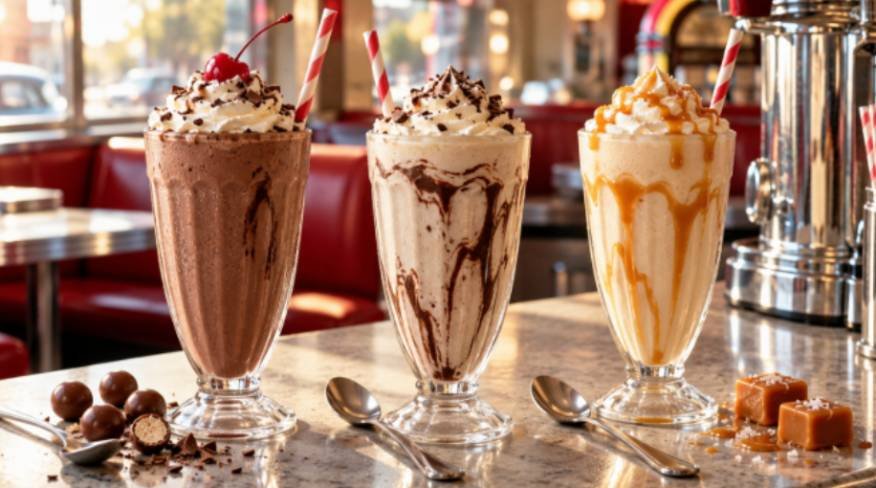
A classic malt relies on two distinct elements: non-diastatic barley malt powder and high-butterfat ice cream. When mixed properly, they form an airy, semi-frozen colloidal suspension that clings to a straw without collapsing into liquid.
Non-Diastatic Malt vs. Grocery Alternatives
In 1873, William Horlick developed malted milk powder as an easily digestible nutritional supplement, an innovation documented by Smithsonian Magazine. The powder blends sprouted barley, wheat flour, and whole milk solids.
For milkshakes, you must use non-diastatic malt powder. Diastatic malt contains active enzymes that break starches down into sugars, which bakeries use to feed yeast in bread dough. Non-diastatic malt has been heat-treated to deactivate those enzymes, leaving behind concentrated, sweet, toasted-grain maltose.
If you drop standard grocery chocolate drink mixes into your blender, you get added cocoa and white refined sugar instead of genuine malt punch. Look for pure non-diastatic barley malt or classic soda fountain staples like Carnation.
Aeration vs. Shearing: Why Modern Blenders Fail
High-powered home blenders run between 20,000 and 30,000 RPM. Their razor-sharp blades shear ice cream apart. That shearing action shatters the microcrystalline ice matrix and generates intense friction heat within 15 seconds. The blade melts milkfat instead of suspending it.
Vintage soda counters never used culinary blenders. They relied on spindle mixers fitted with dull, wavy agitator discs, such as those pioneered by Hamilton Beach Commercial. Spindle discs do not slice or chop.
They fold, whip, and pull air into the milk-fat emulsion, doubling its volume through overrun while keeping temperature spikes near zero. If you only own a standard jug blender, you must alter your pulsing strategy to mimic that low-friction folding effect.
Core Ingredients and the Golden Ratio
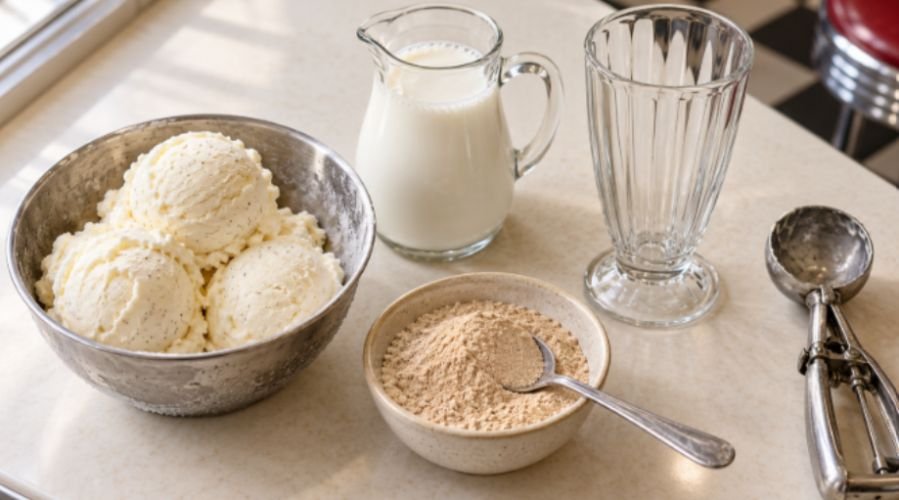
To hit the classic diner profile, you need ingredients meeting specific fat thresholds:
- Super-Premium Vanilla Ice Cream (3 large scoops / 1½ cups / ~250g): Look for an ice cream with 14% to 16% butterfat content and low overrun (minimal pumped air). Low-cost economy tubs contain too much air and water, melting into foamy puddles instantly. As noted by USDA FoodData Central, authentic whole dairy provides the essential milk solids needed for structural viscosity.
- Cold Whole Milk (½ cup / 120ml): Use full-fat, non-homogenized or standard whole milk chilled to 34°F (1°C). Skim or plant-based milks lack the fat globules needed to stabilize the whip.
- Non-Diastatic Malted Milk Powder (¼ cup / 4 tablespoons / ~32g): Do not skimp here. Two tablespoons disappear behind the vanilla profile. Four full tablespoons yield the authentic, roasty malt finish.
- Garnishes (Optional): Hand-whipped heavy cream, a brandied or maraschino cherry, and crushed chocolate-covered malted milk balls.
The exact mass ratio for home blenders sits at 3 parts ice cream to 1 part whole milk by volume. If you run an authentic spindle drink mixer, tighten that ratio to 4:1 or 5:1 because the motor requires far less liquid to agitate the mixture.
Step-by-Step Soda Fountain Master Method
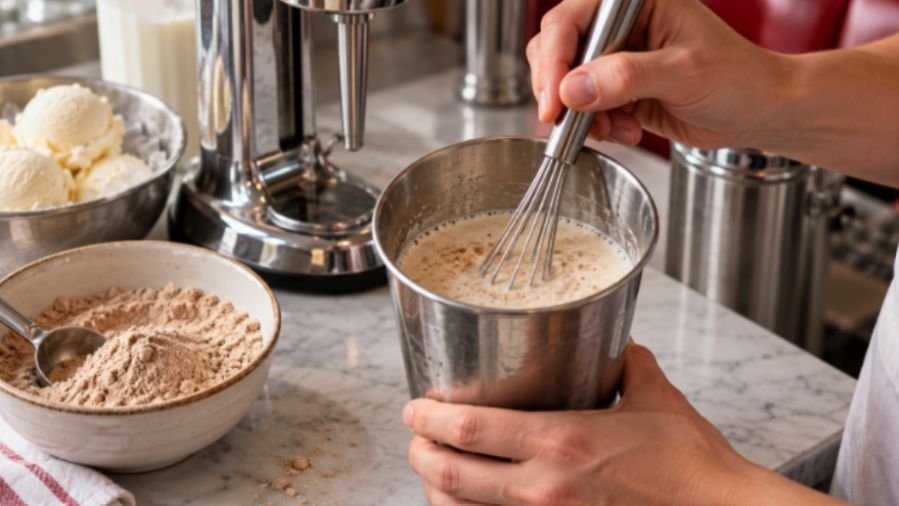
This two-stage procedure prevents graininess and limits blade friction.
Stage 1: The Cold-Milk Malt Slurry
- Place a 16-ounce fluted soda glass in your freezer for 15 minutes.
- Pour ½ cup of cold whole milk directly into your blender pitcher.
- Spoon ¼ cup of malted milk powder over the milk.
- Blend on low speed for 15 seconds until completely dissolved.
Malt powder is intensely hygroscopic, meaning it absorbs moisture rapidly. If tossed on top of frozen ice cream, the powder pulls surface moisture from melting crystals, binding into sticky, impervious clumps that blades simply bat around. Dissolving it into milk first prevents clumps entirely.
Stage 2: Low-Shear Ice Cream Integration
- Pull your ice cream straight from the coldest part of your freezer. It must register around 0°F (-18°C) to absorb the brief heat of the motor.
- Drop three dense, round scoops directly into the malt-milk base.
- Pulse on medium-low speed in short bursts of two to three seconds. Repeat 5 to 7 times.
- Stop immediately once the mixture forms a rolling wave with no dry pockets. Total blade run time must not exceed 20 seconds.
- Pour into your frosted glass, top with whipped cream, and serve with an extra-wide paper or stainless straw.
Food scientists at Serious Eats point out that prolonged mechanical stress destabilizes the delicate balance between ice crystals, liquid water, and fat droplets. Stopping early protects your velvety mouthfeel.
Equipment Showdown: Standard Blender vs. Spindle Mixer
| Parameter | Standard Pitcher Blender | Commercial Spindle Drink Mixer |
| Agitator Design | Sharp, rotating four-point cross-blades | Dull, corrugated wavy disc |
| Primary Action | High-velocity shearing and vortex suction | Low-velocity folding, stretching, and whipping |
| Liquid Requirement | Moderate (½ cup per 1½ cups ice cream) | Minimal (¼ to ⅓ cup per 1½ cups ice cream) |
| Ideal Ice Cream State | Deep frozen (0°F / -18°C) | Slightly tempered (8°F to 12°F / -13°C to -11°C) |
| Run Duration | 15–20 seconds max (pulsed) | 35–45 seconds continuous |
| Finished Texture | Dense, pourable, satin-smooth | Fluffy, whipped, mousse-like |
If using a blender, employ the tamper stick to guide ice cream down toward the blades. Avoid adding extra splashes of milk just to force a spinning vortex.
The Diner Counter Heritage
Classic American soda fountains developed their unique recipes out of functional necessity. Understanding the role of the short order cook in diner culture helps explain why prep speed and physical equipment mattered so much.
Soda jerks operated with mechanical precision, assembling fountain syrups, pulling carbonated taps, and running triple-head mixers side-by-side to serve bustling counters.
Much like discovering why do diners always serve coffee in thick ceramic mugs for heat retention, chilled stainless steel mixing malt cups served an identical thermal purpose. The heavy stainless collar kept dairy chilled while the aerator disc transformed simple pantry powders into culinary staples.
Soda Fountain Flavor Variations
Classic American soda fountains developed their unique recipes out of functional necessity. Understanding the role of the short order cook in diner culture helps explain why prep speed and physical equipment mattered so much, especially when preparing classic diner recipes for a busy counter.
- The Old-School Chocolate Malt: Add 2 tablespoons of Dutch-process cocoa syrup into Stage 1 along with your malt powder. Dutch-process syrup provides a deep, earthy foundation that complements barley notes better than standard corn-syrup chocolate sauces.
- The Black and White Malt: Use whole milk, malt powder, and rich chocolate fudge sauce in the base, but churn it with Mexican vanilla bean ice cream.
- The Orchard Orchard Twist: Blend 2 tablespoons of reduced, salted caramel into Stage 1, followed by standard vanilla scoops. The roasted barley notes harmonize with caramelized sugar.
Frequently Asked Questions
1. What is the difference between a milkshake and a malted milkshake?
A malted milkshake contains dried malted milk powder (malted barley, wheat flour, and evaporated milk solids), giving it a toasted, nutty flavor and a denser texture than a standard milkshake.
2. Why is my homemade malted shake runny instead of thick?
Your blender blades ran too long and melted the dairy fat, or your ice cream had excessive overrun (air) and low butterfat.
3. Can I make a malted milkshake without a blender?
Yes, whisk the malt powder into cold milk inside a wide mason jar, add slightly softened ice cream, seal the lid, and shake vigorously for 60 seconds.
4. Is Ovaltine the same as authentic soda fountain malt powder?
Plain malted Ovaltine works in a pinch, but commercial non-diastatic malt powder provides a much stronger toasted malt profile without added table sugar or artificial vitamins.
Kill the High-Speed Button
Leave the pulverizing smoothies to your health-food blender settings. A proper old-fashioned malt demands respect for cold dairy science, minimal blade contact, and proper malt hydration.
Grab high-fat vanilla ice cream, mix your milk slurry first, and treat your mixer to short, disciplined pulses. Once you taste that thick, toasted malt richness coating the back of a spoon, you will never order a drive-thru shake again.